
Economic Outlook KDI ECONOMIC OUTLOOK | UPDATE 2026.08 August 19, 2026
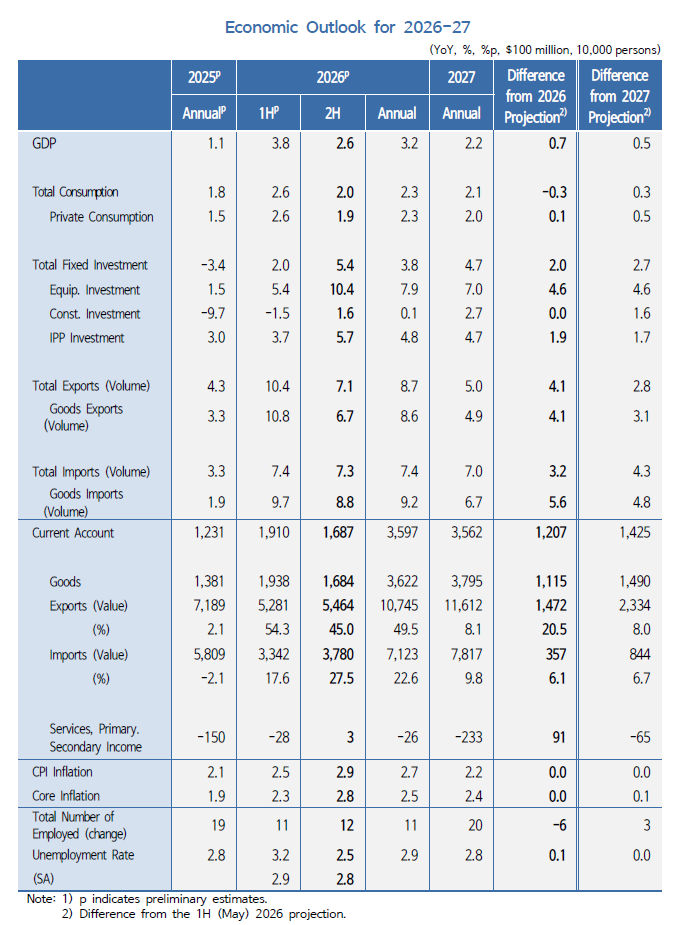
The Korean economy is projected to grow by a strong 3.2% in 2026, supported by favorable conditions in the global semiconductor market, and by 2.2% in 2027.
- Headline inflation is projected at 2.7% in 2026, reflecting higher international oil prices and improved economic conditions, and is expected to decline to 2.2% in 2027 as oil prices stabilize.
- The number of employed persons is projected to increase by 110,000 in 2026, with the increase widening to 200,000 in 2027, reflecting the broader spread of the improvement in domestic demand as well as base effects.
Ⅰ. Current Economic Conditions
- □ The Korean economy has recently recorded strong growth, supported by favorable conditions in the global market for AI-related semiconductors.
- · GDP grew by 0.6% quarter-on-quarter in the second quarter as both exports and domestic demand expanded, while year-on-year growth stood at 3.7%.
- · A sharp increase in semiconductor export prices led to a marked improvement in the terms of trade, with growth in gross domestic income(GDI) substantially outpacing GDP growth.
- □ Exports and equipment investment continued to grow strongly amid favorable conditions in the semiconductor market, while construction investment remained weak.
- · Exports of computers and electronic and optical equipment continued to grow rapidly, and the current account recorded an exceptionally large surplus.
- · Equipment investment expanded, led by semiconductor-related sectors, while construction investment remained weak amid sluggish regional housing markets.
- □ Private consumption has improved only gradually despite the sharp increase in real GDI.
- · Income gains have remained concentrated in semiconductor-related sectors, while subdued real wage growth has limited gains across a broad range of households.
- · With growth concentrated in the semiconductor sector, where employment spillovers are limited, strong economic growth has not translated into a clear improvement in labor market conditions.
- □ Labor market conditions have weakened, particularly among young people, amid persistent weakness in construction and non-semiconductor manufacturing.
- · Employment in these sectors has declined, while growth in service-sector employment has gradually slowed.
- · EInflation has risen above the target amid higher international oil prices and a weaker won, and market interest rates have increased as the policy stance toward rate hikes has strengthened in response.
- □ Global growth has slowed following the shock from the Middle East war, although stronger AI-related investment has partly offset the resulting downward pressure.
- · The recovery in global industrial production has remained limited since the Middle East war, while additional U.S. tariff measures and geopolitical tensions have persisted.
- · Growth differentials across countries have become pronounced, reflecting differences in their degree of integration into global AI supply chains.
Ⅱ. Domestic Economic Outlook for 2026-27
1. Key External Assumptions
- □ Global growth in 2026–27 is assumed to be somewhat weaker than in 2025 owing to the effects of the Middle East war, with global AI investment remaining strong.
- · The IMF projects global growth at 3.0% in 2026 and 3.4% in 2027, with cumulative growth broadly unchanged from its previous forecast.
- ·World Semiconductor Trade Statistics (WSTS) projects global memory semiconductor sales to increase by 302.0% this year and 36.0% next year.
- □ Korea’s crude oil import price (based on Dubai crude) is assumed at $86 per barrel in 2026 and $78 in 2027, both below the previous assumptions.
- □ The Korean won’s real effective exchange rate is assumed to remain broadly unchanged from its recent level.
2. Domestic Economic Outlook
- □ The Korean economy is projected to grow by 3.2% in 2026 and 2.2% in 2027, representing upward revisions of 0.7%p and 0.5%p, respectively, from the previous forecast.
- · Private consumption is projected to grow by 2.3% this year and 2.0% next year, supported by higher real GDI, although the improvement is expected to remain relatively moderate as income gains remain concentrated in the semiconductor sector.
- · Equipment investment is projected to increase by 7.9% this year and 7.0% next year, led by semiconductor-related investment amid expansion in global AI infrastructure investment.
- · Construction investment is projected to increase by only 0.1% this year amid weak regional property markets and higher construction costs, before rising by 2.7% next year, supported in part by the expansion of semiconductor production facilities.
- · Exports are projected to grow by 8.7% this year and 5.0% next year, supported by strong global AI investment despite U.S. tariff measures and geopolitical uncertainty in the Middle East.
- · The current account is projected to record a large surplus of around $360 billion in both this year and next year, as the sharp increase in semiconductor prices boosts export values.
- □ Headline inflation is projected at 2.7% this year, reflecting higher international oil prices and improved economic activity, before declining to 2.2% next year as oil prices stabilize.
- · Core inflation is projected at 2.5% this year and 2.4% next year, with the forecast for next year revised up by 0.1%p to reflect the upward revision to private consumption.
- □ The number of employed persons is projected to increase by 110,000 in 2026, with the increase widening to 200,000 in 2027, reflecting the broader spread of the improvement in domestic demand as well as base effects.
- · The unemployment rate is projected at 2.9% this year and 2.8% next year.
3. Risks to the Outlook
- □ The Korean economy remains highly dependent on global semiconductor demand, meaning that shifts in the semiconductor cycle could increase volatility across the broader economy.
- · Growth could slow rapidly if demand for AI investment weakens or intensifying competition among semiconductor-producing countries reduces the global market share of Korean firms.
- · Conversely, growth could exceed the forecast if demand for AI investment remains strong and domestic firms expand their supply capacity faster than expected.
- · Persistent uncertainty surrounding U.S. tariff policy, a renewed escalation of conflict in the Middle East, and heightened stock market volatility could also constrain the improvement in economic activity and private consumption.

Security code
![captcha]()
We reject unauthorized collection of email addresses posted on our website by using email address collecting programs or other technical devices. To access the email address, please type in the characters exactly as they appear in the box below.
KDI Staff Information
Please enter the security code to prevent unauthorized information collection.
KDI Staff Information
KDI Staff Information