
KDI FOCUS Declining Cognitive Skills among Korean Workers: Drivers and Improvement Measures January 14, 2026
Declining Cognitive Skills among Korean Workers: Drivers and Improvement Measures
January 14, 2026-
MinSub Kim
 프로필
프로필
-
KDIPARK, Yoonsoo

 Strengthening workforce competencies and labor productivity has become increasingly important amid rapid advances in automation and industrial transformation. However, international comparative findings show that the cognitive skills of Korean workers decline steeply with age, raising concerns about labor productivity. While multiple factors contribute to this decline, the primary driver appears to be a wage structure that provides insufficient incentives for skills development. To promote labor productivity growth, wage systems based on skills and performance need to be expanded, alongside the provision of broader opportunities for upskilling and reskilling.
Ⅰ. Strengthening Cognitive Skills for Workers
Skills, a form of human capital embodied in individuals, are the competencies required to perform tasks in the workplace and are a key determinant of labor productivity. Among these, cognitive skills—particularly mathematical reasoning (numeracy) and reading comprehension and critical thinking (literacy)—provide the foundational capacity for mastering advanced technologies and performing complex tasks in the modern economy. Schooling and training are investments in human capital to develop skills, whose economic returns are realized in the form of wages in the labor market. Thus, cognitive skills function both as a means of increasing wages at the individual level and as a key driver of economic growth at the national level.
Adapting to advances in AI and evolving job tasks requires raising labor productivity through broad-based improvements in workers’ cognitive skills.
The importance of cognitive skills has become increasingly pronounced amid rapid advances in artificial intelligence (AI) and automation. During the earlier era of manufacturing-led industrialization, workers could remain in the same job until retirement after mastering job tasks in their youth, based on the numeracy and literacy acquired through formal education. In contrast, as lifetime employment has become less prevalent and workers face rapid task reconfiguration and industrial transition, today’s workers are required not only to acquire new skills in early adulthood but also to continue developing skills throughout their working lives and to apply them to changing job demands. Because cognitive skills constitute the foundational capacity for successfully undertaking such learning and training, equipping not only young workers but also middle-aged and older workers with high levels of cognitive proficiency has emerged as a key challenge of our time.
Against this backdrop, this study assesses the level of cognitive skills among Korean workers and discusses policy directions for enhancing labor productivity.
Ⅱ. Age-related Decline in Cognitive Skills among Workers
The Programme for the International Assessment of Adult Competencies (PIAAC), administered by the Organisation for Economic Co-operation and Development (OECD) at approximately ten-year intervals, is an international survey that objectively measures and enables crossnational comparison of the core competencies of adults aged 16–65, thereby providing a key evidence base for the formulation of economic and social policies. The survey assesses essential information-processing skills required in modern societies, including numeracy, literacy, and problem solving. Among these, the cognitive skill indicators of numeracy and literacy were measured using a consistent methodology in both Cycle 1 (2011–2012) and Cycle 2 (2022–2023), making it possible to examine how adults’ cognitive skills have changed over the past decade. Rather than examining the entire adult population, this study focuses on the cognitive skills of economically active workers and conducts cross-country comparisons among employed adults who have completed formal education
Figure 1 illustrates numeracy and literacy scores by age group for workers in Korea and other countries. Among workers in their 20s, Korean workers aged 25–29 ranked relatively high in the Cycle 1 survey, placing 6th in numeracy and 4th in literacy among the 17 OECD countries included in the analysis.By contrast, in the Cycle 2 survey conducted about ten years later, Korea ranked 8th in both numeracy and literacy, with scores close to the OECD average across 17 countries. Despite Korea’s substantial investment in youth education and strong educational aspirations, the reasons for the decline in cognitive skills among workers in their 20s remain unclear and call for further research. Possible contributing factors include the steady rise in the share of middle and high school students below minimum proficiency and a decline in investment in university education over the past decade. These patterns suggest the need to reassess the effectiveness of Korea’s higher education system in developing cognitive skills.
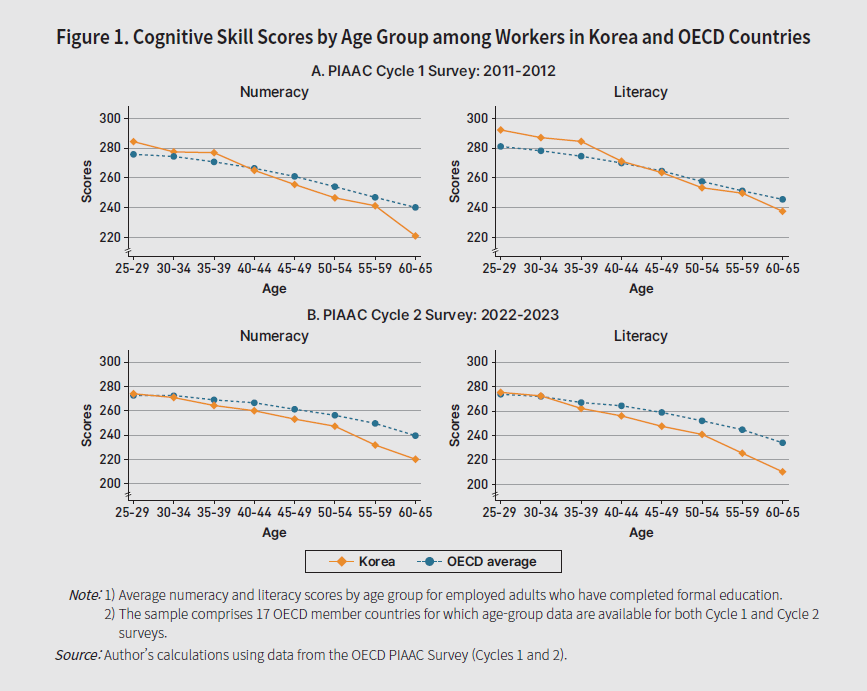
Of particular concern is the fact that Korean workers exhibit a much steeper age-related decline in cognitive skills (the slopes in Figure 1) than workers in other countries.7) In the Cycle 1 survey, Korea’s numeracy and literacy scores were above the OECD average among workers in their 20s and 30s but declined rapidly thereafter, falling below the average in the 40s and widening further in the 50s and 60s. A similar pattern is observed in the Cycle 2 survey, where scores among Korean workers aged 30–34 remained close to the OECD average but fell well below it among those aged 60–65. As Figure 1 illustrates, this decline accelerates especially after the mid-50s.
The cognitive skills of Korean workers have not only declined over the past decade but also exhibit an unusually rapid depreciation with age, raising concerns regarding both labor productivity and the effective utilization of older workers.
The steep age-related depreciation of cognitive skills observed among Korean workers is even more pronounced when compared with major advanced economies. Notably, this deterioration in Korea is already evident in young adulthood. Based on the Cycle 2 survey, the numeracy and literacy scores of Korean workers aged 40–44 were lower by 14.10 and 18.94 points, respectively, than those of workers aged 25–29, which is a substantially larger decline than that observed in other OECD countries (Table 1). In the U.S., Japan, and Italy, cognitive skills do not decline markedly during young adulthood. Unlike in these advanced economies, cognitive skill loss among Korean workers begins as early as their 20s and 30s.
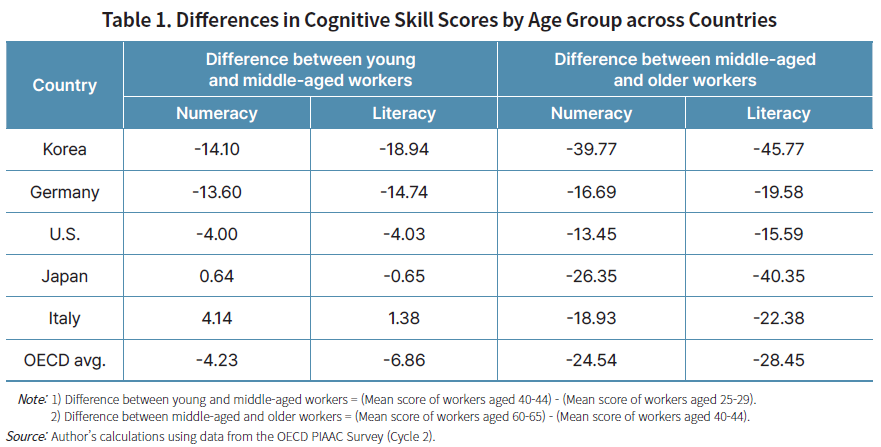
The age-related deterioration in cognitive skills accelerates further during middle and older age. As shown in Table 1, the magnitude of this decline in Korea is considerably larger than in other advanced economies. While some degree of skill loss over the life cycle may be natural, the much faster pace of decline in Korea relative to other countries is a source of concern.
Meanwhile, because Figure 1 and Table 1 compare workers of different ages at a single point in time, cohort-specific characteristics—such as intergenerational differences in educational attainment—may be conflated with pure age-related skill loss. To address these cohort effects and more rigorously capture skill changes attributable to aging within the same generation, the Appendix reports results from a cohort-tracking analysis that links Cycle 1 and Cycle 2 data over an approximately ten-year period, following approaches used in previous studies (Yi et al., 2024; Lee et al., 2025). Although this analysis is subject to limitations in fully controlling for a wide range of potential confounding factors due to the data covering only two time points (2011–12 and 2022–23), it nonetheless suggests that Korean workers experience a relatively rapid decline in cognitive skills with age.
Skill depreciation among Korean workers is marked by (1) an early onset in young adulthood and (2) an exceptionally rapid decline with age.
In sum, Korean workers exhibit two distinctive patterns of age-related decline in cognitive skills: (1) an early onset in young adulthood and (2) a very rapid pace of decline over the life cycle. These patterns are especially concerning given Korea’s demographic decline, which makes higher labor force participation and sustained labor productivity among older workers increasingly important. In other aging societies, such as Japan, Germany, and Italy, cognitive skill levels do not show a clear decline during young adulthood, nor is a sharp deterioration observed in middle and older age.
III. Wage Systems with Weak Incentives for Skills Development
There are a range of potential factors that could be contributing to the unusually rapid loss of cognitive skills among Korean workers as they age. One explanation is constrained opportunities for skills development in adulthood. First, long and rigid working hours deprive workers of the time needed for upskilling (Korean Educational Development Institute, 2024). Second, the effectiveness of existing learning and training programs is limited, leading to low participation rates in lifelong learning (Chae, 2021; 2022). In addition, work practices and organizational culture may contribute to skill depreciation: low job autonomy, rigid work cultures, and inadequate human resource systems for human capital development restrict opportunities for workers to apply and develop their skills on the job, which may lead to skill depreciation over time (Ban et al., 2017; 2020).
Factors contributing to the rapid age-related decline in cognitive skills appear to include limited opportunities for skill development in adulthood: long and rigid working hours, ineffective learning and training programs, and workplace environments that prevent workers from developing skills.
Moreover, the literature points to a misalignment between compensation and workers’ skills (Park, 2022; Lee et al., 2025). Just as education during adolescence represents an investment in human capital aimed at increasing future earnings, learning and training during adult working life can be regarded as investments intended to raise expected income through skill acquisition and higher labor productivity. Unless wages adequately reflect gains in performance (higher labor productivity), workers lack the incentive to devote time and effort to upskilling, making meaningful skill improvement unlikely. Put differently, aligning wages more closely with workers’ skills or performance is a fundamental prerequisite for fostering skills development.
However, a persistent concern in Korea’s labor market is the misalignment between workers’ skills and compensation. According to the Ministry of Employment and Labor’s Supplementary Survey on the Labor Force Survey at Establishments (June 2025), 63% of establishments lack a formal wage system (basic wage framework), leaving wage-setting standards unclear. Only 9.5% and 8.6% of establishments operate skill-based and job-based pay systems, respectively, that can more directly reflect workers’ competencies and job performance. In the absence of wage structures grounded in individual skills or performance, wages tend to be determined primarily by tenure (Lee, 2021; Hong and Kim, 2023; Nam and Lee, 2024). To the extent that workers’ skills are not compensated adequately, the disincentive to invest in skill development may lead to more rapid skill depreciation in Korea.
The absence of wage systems that incentivize voluntary skill development is suggested as a key factor behind Korea’s rapid skill decline.
To examine the extent to which workers’ skill sets are rewarded through wages, this study conducts an international comparative analysis using data from the PIAAC. The PIAAC Cycle 1 survey (2011–12) provides detailed information on workers’ wages, cognitive skill scores, and tenure, as well as demographic characteristics, including gender, age, and educational level, and job characteristics, such as employment status (regular versus non-regular), establishment size, industry, and occupation. Using employed adult workers who have completed formal education as the sample, this study employs a regression model with log hourly wages as the dependent variable to estimate country-specific wage returns to cognitive skills and tenure.
For Korean workers, the expected wage return to cognitive skills is roughly half the level observed in OECD peers such as Germany, Japan, and the United States, leaving weak incentives for voluntary upskilling.
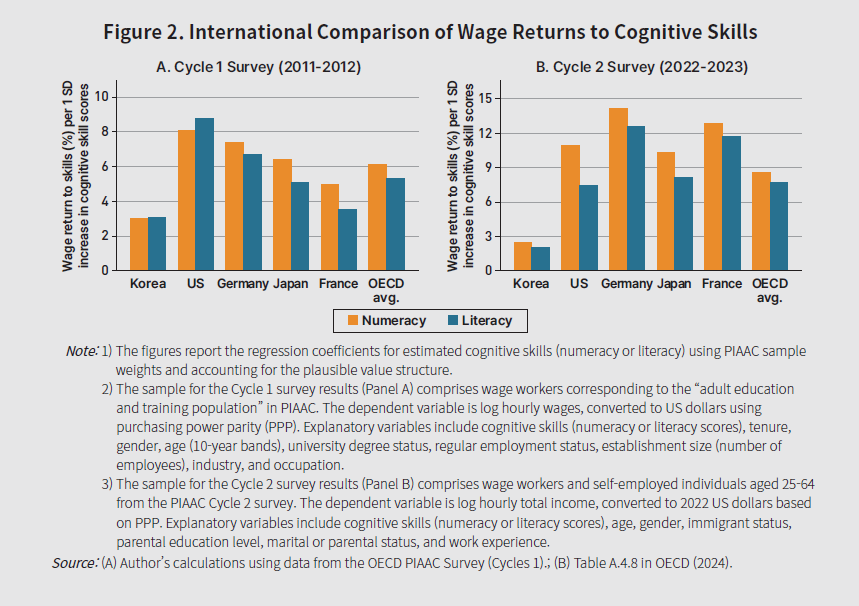
Figure 2A presents the estimated returns to cognitive skills across countries. Cognitive skills are proxied using either numeracy scores (orange bars) or literacy scores (blue bars). Using numeracy as the measure of cognitive skills, in Korea, a one-standard-deviation (SD) increase in numeracy scores is associated with only a 2.98% increase in wages—less than half the average across the 27 countries analyzed (6.13%) and well below the corresponding estimates for major advanced economies, including the US (8.10%), Germany (7.38%), Japan (6.43%), and France (4.99%). These results indicate that the wage returns Korean workers can expect from improvements in cognitive skills are substantially lower than those observed in other advanced economies. A similar pattern emerges when literacy is used as the measure of cognitive skills. A one-SD increase in literacy scores is associated with the highest wage increase in the United States (8.79%), followed by Germany (6.69%), Japan (5.08%), France (3.51%), and Korea (3.05%), compared with an average of 5.31% across the 27 countries.
Given that these findings are based on data from 13–14 years ago (Cycle 1, 2011–2012), it is important to assess whether they still hold using more recent data. Although the 2022–2023 Cycle 2 data would be ideal for such analysis, key variables such as wages and industry are not yet publicly available for most countries, including Japan, Germany, and the United States. This limits the scope for international comparison. Nonetheless, recent trends can be inferred from OECD (2024), which reports results from a comparable analysis using the Cycle 2 data (see Note 3 to Figure 2).
Figure 2B presents results from OECD (2024). Although some differences in samples and model specifications make precise numerical comparisons with Figure 2A challenging, the results nonetheless indicate that wage returns to cognitive skills in Korea remain notably low even with more recent data. This conclusion holds regardless of whether numeracy or literacy is used as the measure of skills. In Korea, a one-SD increase in numeracy or literacy scores is associated with wage gains of only 2.46% and 2.01%, respectively, compared with average increases of 8.16% and 7.65% across the 22 OECD countries analyzed. The low returns to cognitive skills in Korea stand in clear contrast to Germany and Japan, which exhibit substantially higher returns to cognitive skills (Germany: 14.14% for numeracy and 12.58% for literacy; Japan: 10.34% and 8.15%, respectively) despite having entered population aging earlier than Korea and also having manufacturing-intensive industrial structures similar to Korea.
Korea’s wage structure (1) places substantially greater weight on tenure than on competencies and (2) exhibits large wage differentials by firm size.
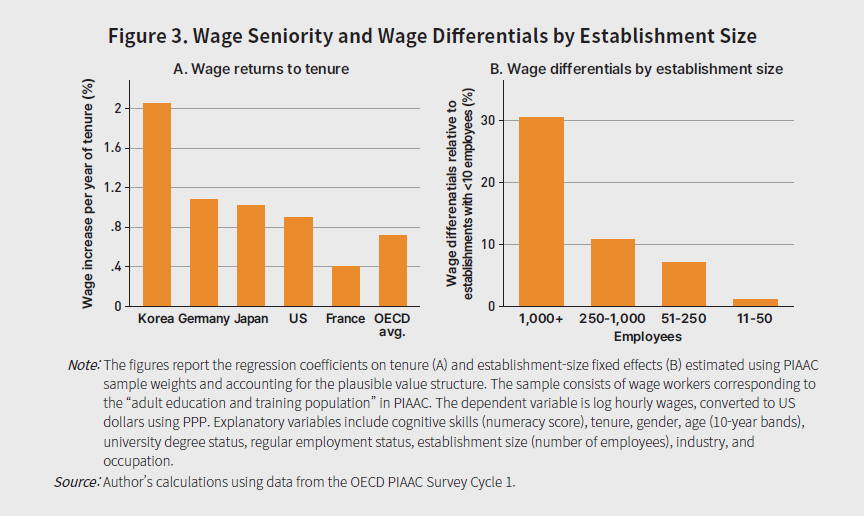
Beyond the low returns to cognitive skills, Korea’s wage structure exhibits two additional features: (1) steep tenure-based pay growth and (2) sizable wage differentials by firm size (Figure 3). First, tenurerelated wage growth is considerably stronger than in other OECD countries. In the Cycle 1 survey (2011–2012), wages for Korean workers rose by 2.05% for each additional year of tenure, far exceeding those for France (0.41%), the U.S. (0.89%), Japan (1.03%), and Germany (1.08%). The average across the 27 OECD countries analyzed was only 0.71%.
Second, large wage differentials by firm size remain pronounced. The Cycle 1 results show that, relative to establishments with 10 or fewer employees, wages are higher by 1.00% in firms with 11–50 employees, by 7.09% in those with 51–250 employees, by 10.72% in those with 251–1,000 employees, and by up to 30.49% in firms employing 1,000 or more workers.
Combined with low returns to cognitive skills, seniority-based pay and large wage gaps by firm size suggest that Korean workers prioritize securing stable employment at large firms early in their careers over continuous, life-long skill development. This incentive structure helps explain why the young generation of Korean workers avoids small and medium-sized firms and rarely engages in sustained skill accumulation once employed.
This wage structure weakens incentives for post-entry skill development while intensifying inefficient credential competition for early-career entry into large firms.
From a national economic perspective, this labor market environment may generate significant inefficiencies that hinder the effective allocation of human resources and reduce labor productivity. First, excessive competition for academic credentials and résumé-building unrelated to job performance entails large social costs. Second, underinvestment in skill development during mid- and late-career stages leads to faster depreciation of human capital. Third, “late bloomers” who reach their full potential in mid- or late-career are denied opportunities to demonstrate their competencies and receive commensurate rewards.
Ⅳ. Policy Directions for Enhancing Workforce Skills
While workers’ skills have always underpinned labor productivity, their role has become a critical national imperative amid rapid advances in automation technologies, including AI. Adapting to task reconfiguration and industrial shifts from automation demands a workforce capable of leveraging cognitive skills to adapt swiftly to evolving job requirements. Consequently, continuous upskilling and reskilling, beyond initial employment, are no longer optional.
In light of the findings in this study, however, Korea may not be fully prepared for technological transformation in terms of workforce cognitive skills. Unlike in the past, Korean workers in their 20s and 30s no longer exhibit a clear comparative advantage over their counterparts in major advanced economies, and the rapid age-related decline in cognitive skills among middle-aged and older workers is a significant concern for labor productivity. These patterns underscore the need to assess the competitiveness of higher education and the effectiveness of training programs for current workers.
Broader adoption of skill- and job-based pay systems is needed to strengthen incentives for workers to develop their skills.
Wage systems that reward skills and the performance workers generate are a first-order requirement for workforce and productivity improvement. Workers will invest meaningful time and effort in skills development only when returns are commensurate with their efforts. As noted earlier, however, returns to cognitive skills in Korea remain markedly lower than in most other advanced economies. Broader adoption of skill- and job-based pay systems is therefore essential to provide workers with incentives for skill development. A necessary first step involves clarifying job roles and responsibilities and establishing transparent performance evaluation systems.
Workers should be given meaningful opportunities to build their skills through greater autonomy over working hours, more effective learning and training programs, and workplace environments that enable full use of their competencies.
Building upon compensation structures that reward skill and performance as an initial measure, achieving substantial progress in workforce skills requires additional policy measures. As emphasized in the studies reviewed in this paper, priority should be given to expanding opportunities and improving the institutional environment for training. Institutional mechanisms that adjust working hours or improve labor flexibility should be strengthened to ensure that motivated workers can secure sufficient time for upskilling. Simultaneously, the effectiveness of training systems should be bolstered by improving program quality and linking outcomes to career and wage progression. Lastly, work practices, organizational culture, and human resource management should be realigned to fully leverage workers’ skills.
Appendix
The analysis in Figure 1 compares workers of different ages within a single year and therefore reflects not only age-related skill decline but also differences in characteristics between cohorts. To control for such cohort effects, Appendix Figure 1 presents a cohort analysis that links data from the PIAAC Cycle 1 and Cycle 2, tracking changes in cognitive skill scores within the same cohorts over time. This analysis of skill changes over eleven years confirms the patterns in Figure 1: Korea exhibits relatively large skill depreciation across all cohorts, with the decline becoming evident as early as the 20s and accelerating further after age 50.
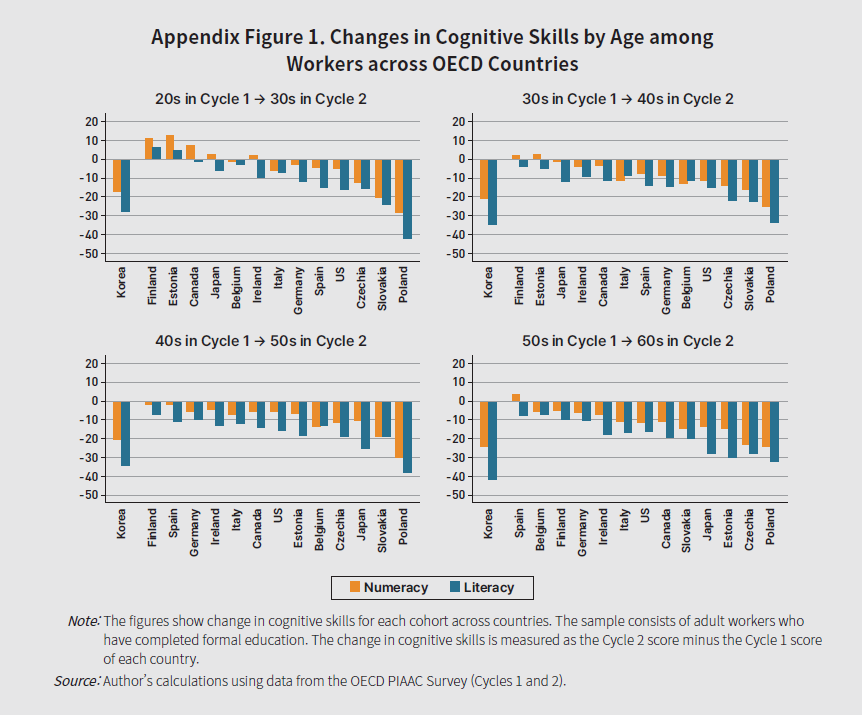
The cohort-tracking analysis in Appendix Figure 1 rests on the assumption that the Cycle 1 and Cycle 2 samples are comparable. For Korea, this assumption is supported by the fact that years of education for each cohort, which is closely related to cognitive skills, show no statistically significant differences between the samples. Nonetheless, the possibility of unobserved differences stemming from changes in survey design or response behavior cannot be fully ruled out with only two observation points. Even so, given that both Figure 1 and the Appendix Figure 1 consistently show a substantial age-related decline in cognitive skills, it is reasonable to conclude that Korean workers experience a more rapid age-related depreciation in skills than their counterparts in other advanced economies.
- CONTENTS
-
- I. Strengthening Cognitive Skills for Workers
- II. Age-related Decline in Cognitive Skills among Workers
- III. Wage Systems with Weak Incentives for Skills Development
- IV. Policy Directions for Enhancing Workforce Skills
- Appendix
- Key related materials
We reject unauthorized collection of email addresses posted on our website by using email address collecting programs or other technical devices. To access the email address, please type in the characters exactly as they appear in the box below.
Please enter the security code to prevent unauthorized information collection.