
Policy Study Income Support in Response to Labor Market Shocks: Korea‘s Basic Livelihood Security System August 29, 2025
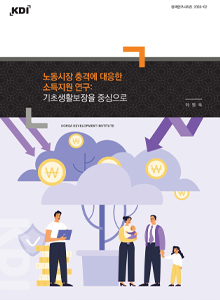
Series No. 2025-02
Policy Study
KOR
Income Support in Response to Labor Market Shocks: Korea‘s Basic Livelihood Security System
#Employment·Unemployment
#Welfare Policy
August 29, 2025
-
Youngwook Lee
 프로필
프로필
- Summary
-
This study examines how labor market conditions and labor policy changes affect benefit receipt under Korea’s National Basic Livelihood Security (NBLS) system. Given the substantial coverage gaps in employment insurance, NBLS serves as the last-resort safety net for low-income individuals who are able to work. Assessing its responsiveness to economic shocks and policy changes is essential for evaluating the effectiveness and limitations of the current income support system.
First, the study analyzes the responsiveness of NBLS benefit receipt and expenditures to key labor market indicators, such as the unemployment rate and the employment rate. The results show that, overall, NBLS has not exhibited meaningful counter-cyclical responsiveness to labor market fluctuations. Although a modest increase in benefit responsiveness to the unemployment rate is observed following the 2015 reform, responsiveness remains broadly limited ― even during the COVID-19 period. However, in contrast to the weak correlation with the aggregate employment rate, declines in the employment rate of middle-aged unpaid family workers show a clear association with increases in NBLS receipt. These findings suggest that NBLS has limited responsiveness to labor market fluctuations among the working population, though it appears responsive for specific vulnerable groups such as unpaid family workers.
Second, the study examines the effects of minimum wage increases ― a key labor policy targeting vulnerable workers ― on NBLS benefit receipt. The analysis shows that sharp minimum wage hikes increased both overall NBLS receipt and livelihood benefit receipt, particularly among middle-aged individuals. Monthly analyses that control for other NBLS reform effects also confirm that minimum wage increases raised benefit receipt among the working-age population. Moreover, this increase was driven primarily by new entrants to NBLS rather than by a slowdown in exits.
These findings align with the earlier results showing that NBLS receipt is particularly responsive to labor market shocks among certain vulnerable groups, such as middle-aged unpaid family workers. Previous studies have shown that minimum wage increases reduce employment rates among vulnerable groups in the labor market, including the self-employed and unpaid family workers. Taken together, the analysis suggests that employment shocks experienced by unpaid family workers may constitute a key channel through which NBLS benefit uptake rises ― particularly among the middle-aged population.
This paper emphasizes the importance of establishing and strengthening an income support system that is responsive to labor market dynamics, especially in light of anticipated structural changes and labor policy reforms. Moreover, because labor and welfare policies often target overlapping populations and interact in practice, it is essential to carefully consider these interconnections in the design and implementation of related policies.
- Contents
-
Abstract (ENG)
Preface
Summary (KOR)
Chapter 1. Introduction
Chapter 2. Research Background
Section 1. National Basic Livelihood Security System
Section 2. Related Literature
Chapter 3. Labor Market Responsiveness of NBLS Benefit Receipt
Section 1. Overview of the Analysis
Section 2. Analysis Results
Chapter 4. Policy Responsiveness of NBLS Benefit Receipt: The Impact of Minimum Wage Increases
Section 1. Overview of the Analysis
Section 2. Analytical Findings
Chapter 5. Conclusion and Policy Implications
Section 1. Summary of Findings
Section 2. Policy Directions
References
If you want to know more in detail?
related materials ( 9 )
- Key related materials
Security code
![captcha]()
We reject unauthorized collection of email addresses posted on our website by using email address collecting programs or other technical devices. To access the email address, please type in the characters exactly as they appear in the box below.
KDI Staff Information
Please enter the security code to prevent unauthorized information collection.
KDI Staff Information
KDI Staff Information