
Policy Study The Macroeconomic Effects of Social Welfare Reform in South Korea December 31, 2022
Series No. 2022-13
Policy Study
KOR
The Macroeconomic Effects of Social Welfare Reform in South Korea
#General(Other)
#General(Other)
December 31, 2022
-
Kyooho Kwon
 프로필
프로필
- Summary
-
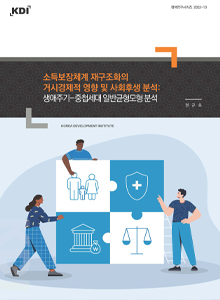
This study examines the macroeconomic and welfare impacts of replacing South Korea’s targeted income support programs with a universal income support system. A life-cycle overlapping generations (OLG) model with heterogeneous households is constructed to reflect existing programs, such as basic livelihood assistance, child allowances, earned income credits, and public pensions, and to incorporate institutional features and household-level income distribution, including joint household labor decisions.
Simulations of five policy scenarios show that universal benefit increases aggregate output but reduces social welfare due to weaker safety net effectiveness. Program impacts vary, suggesting well-designed targeted schemes may outperform universal income support. Findings also highlight the importance of aligning income support policies with household needs while ensuring fiscal sustainability.
- Contents
-
Abstract (ENG)
Preface
Summary (KOR)
Chapter 1. Background and Purpose of the Study
Chapter 2. Model Economy
Chapter 3. Benchmark Economy
Section 1. Setting the Benchmark Economy
Section 2. Analysis of the Benchmark Economy
Chapter 4. Policy Simulation Experiments
Chapter 5. Summary and Conclusion
References
If you want to know more in detail?
related materials ( 9 )
- Key related materials
Security code
![captcha]()
We reject unauthorized collection of email addresses posted on our website by using email address collecting programs or other technical devices. To access the email address, please type in the characters exactly as they appear in the box below.
KDI Staff Information
Please enter the security code to prevent unauthorized information collection.
KDI Staff Information
KDI Staff Information