
Policy Study On City Size Distribution: Determinants, Spatial Policies, and Welfare December 31, 2025
Series No. 2025-04
Policy Study
KOR
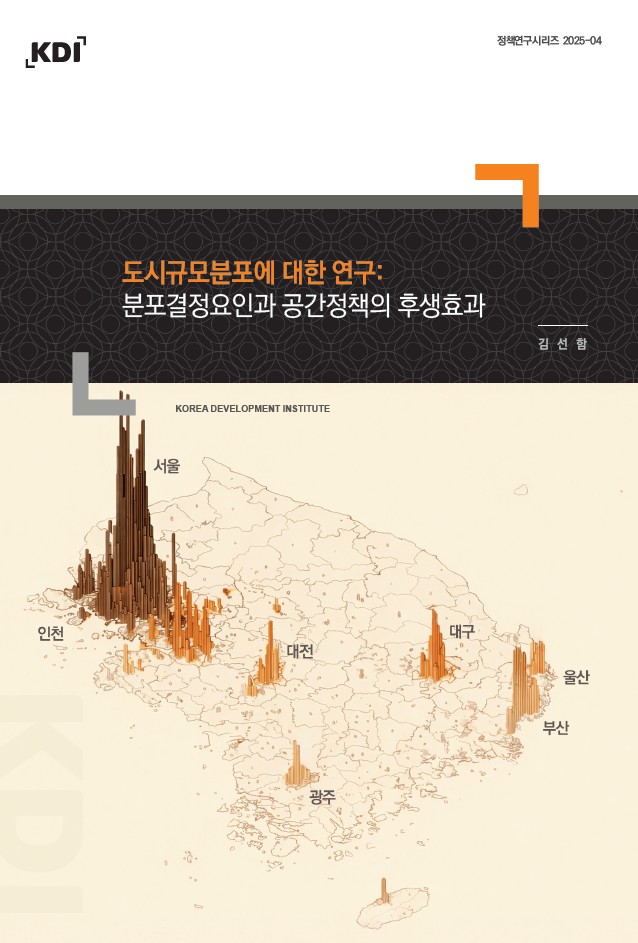
On City Size Distribution: Determinants, Spatial Policies, and Welfare
#Urban, Rural and Regional Economics
December 31, 2025
-
Sunham Kim
 프로필
프로필
- Summary
-
This study employs a quantitative spatial general equilibrium model to estimate the determinants of city size distribution in South Korea and quantify the effects of regional policies, evaluating the optimality of its current population distribution.
Defining 161 cities and counties nationwide as cities and analyzing data from 2005 to 2019, the study finds that differentials in total factor productivity (TFP) drove up the population share of the Seoul Metropolitan Area (SMA), while amenities and urban accommodation costs worked in the opposite direction. In particular, the TFP decline among non-SMA manufacturing cities, such as Geoje, Gumi, and Ulsan, during the 2010s accelerated concentration in the SMA. Although regional development initiatives in this period, including innovation cities and Sejong City, improved local infrastructure and supported moderate population growth, weak TFP gains limited their impact on alleviating SMA concentration.
Counterfactual policy experiments that designate seven non-SMA cities as regional hubs reveal that restoring the SMA population share to its 2000 level would require substantial improvements in TFP and urban accommodation costs. The upper bound of policy costs justifiable without welfare loss is limited, and even with such investments, the SMA would still account for nearly half the national population. The optimal spatial policy analysis further suggests that efficient utilization of agglomeration economies favors population concentration in major cities across the country. With population reallocating not only to Seoul but also to major non-SMA cities, such as Busan, Daegu, and Gwangju, the SMA concentration may not rise beyond its 2019 level.
These findings offer three policy implications. First, for regional development policies to be effective, they must include measures that boost regional productivity. Second, even under optimistic scenarios, reducing the SMA share below 40% remains challenging, suggesting that policy goals should be realistic and strategically focused. Third, to prevent further SMA concentration, proactive spatial restructuring through the development of regional hub cities could provide a path forward consistent with the Pareto optimum.
- Contents
-
Abstract (ENG)
Preface
Summary (KOR)
Chapter 1 Introduction
Chapter 2 Literature Review
Chapter 3 Spatial Model
Section 1 Definition of the Model
Section 2 Identification of the Model
Chapter 4 Methodology and Data
Section 1 Defining the Spatial Boundaries of Cities
Section 2 Overview of Data and Parameter Settings
Section 3 Validation of the Model
Chapter 5 Empirical Results
Section 1 Estimation of Urban Characteristic Parameters
Section 2 General Equilibrium Simulation Analysis
Chapter 6 Conclusion
References
Appendix
If you want to know more in detail?
related materials ( 9 )
- Key related materials
Security code
![captcha]()
We reject unauthorized collection of email addresses posted on our website by using email address collecting programs or other technical devices. To access the email address, please type in the characters exactly as they appear in the box below.
KDI Staff Information
Please enter the security code to prevent unauthorized information collection.
KDI Staff Information
KDI Staff Information