
News The 11th Korea-OECD International Forum on Budgeting concludes successfully
The 11th Korea-OECD International Forum on Budgeting concludes successfully

The 11th Korea-OECD International Forum on Budgeting concludes successfully
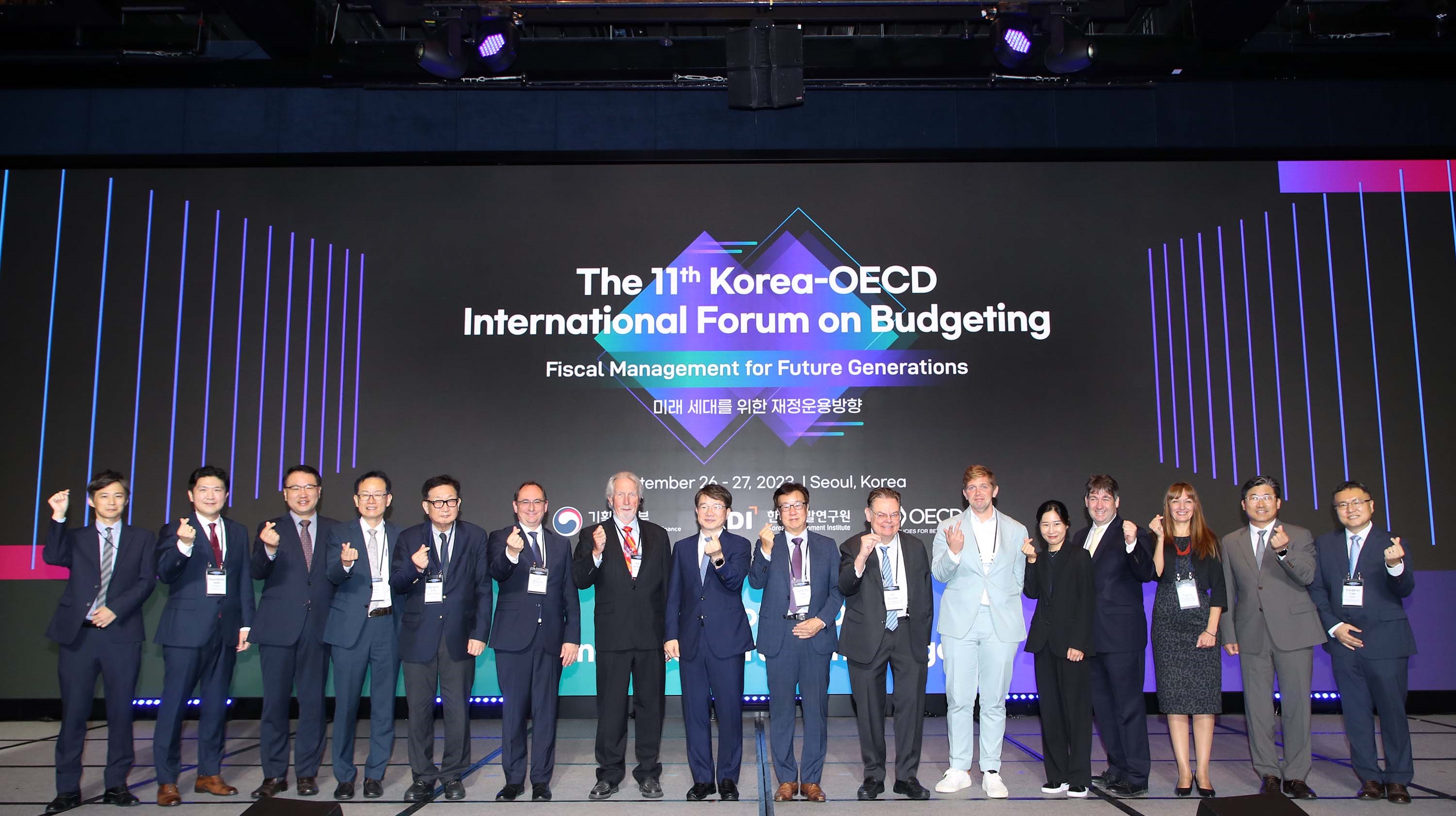
On S eptember 26th and 27th,「The 11th Korea-OECD International Forum on Budgeting」was held at the JW Marriott Hotel in Seoul, with the theme of 'fiscal management for future generations.' The event was hosted by the Ministry of Economy and Finance and jointly organized by KDI and OECD.
The Forum, which has been held in Seoul or Paris since 2009, is a platform for in-depth discussions on the role of finance. In this forum, about 20 experts in finance from OECD member countries such as the United States, the United Kingdom, Belgium, Greece, Hungary, Japan, as well as the EU, attended including Dongil Kim, the Deputy Minister for Budget at the Ministry of Economy and Finance, Dongchul Cho, the President of KDI, and Barry Anderson, the Chairman Emeritus of the OECD Committee of Senior Budget Officials.
The theme of this forum, 'fiscal management for future generations," was selected to address major challenges in achieving fiscal sustainability amidst economic slowdown, low fertility rates, an aging population, declining government revenue, and increased welfare spending. It also aimed to discuss and formulate solutions by sharing international cases and opinions in the face of changing domestic and international circumstances, such as the spread of global warming.
The first day of the forum began with an opening speech by Dongil Kim, the Deputy Minister for Budget at the Ministry of Economy and Finance, followed by a welcome address from Dongchul Cho, the President of KDI, and a congratulatory speech by Barry Anderson, the Chairman Emeritus of the OECD Committee of Senior Budget Officials.
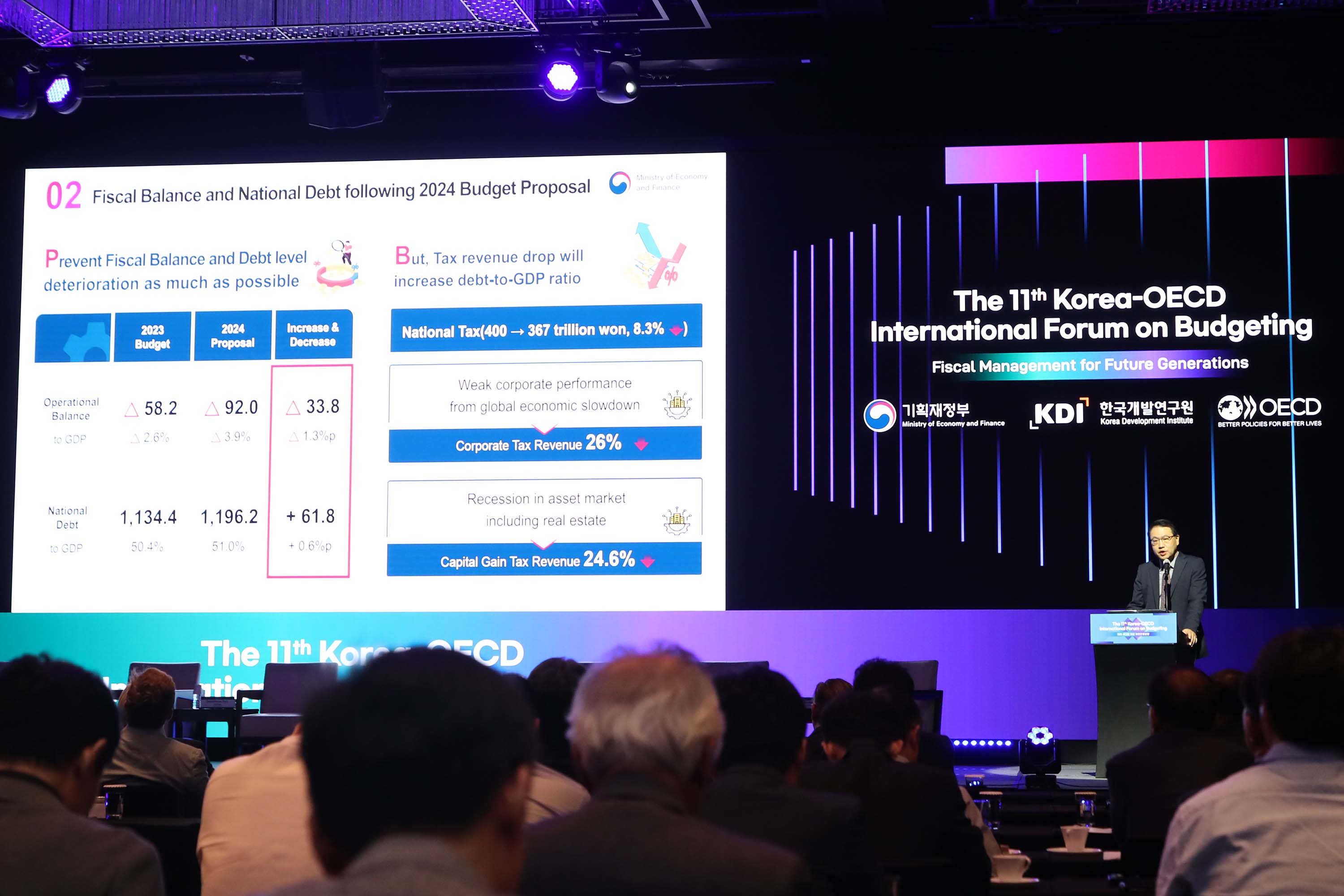
The day included presentations and discussions in three sessions. In the first session, Byungseo Yoo, the Director-General for Budget Coordination in the Ministry of Economy and Finance, explained South Korea's fiscal trends and discussed the fiscal conditions and sustainability of various countries. The second session examined the application of green budgeting and environmental impact assessments in South Korea and major countries as part of their response to the climate crisis. The third session focused on the need for fiscal expenditure innovation and discussed the direction for both quantitative and qualitative expenditure restructuring.
Session 1. Financial Sustainability and Fiscal Rules
In this session, chaired by Professor Jungsik Kim of Yonsei University, prominent figures from both domestic and international arenas participated as speakers to discuss topics such as ▲ South Korea's fiscal normalization after COVID-19, ▲ Belgium's fiscal soundness, ▲ and Japan's fiscal trends. The presentations and discussions aimed to share efforts from various countries to ensure fiscal sustainability.
Byungseo Yoo, Director General for Budget Coordination in the Ministry of Economy and Finance, introduced South Korea's fiscal objectives for 2024 and its medium-to-long-term fiscal plans, established to achieve fiscal normalization during the pandemic period. Luc Mabille, Director General of Budget in Belgium, presented Belgium's mid-term fiscal goals and fiscal management policies like Six-pack and Two-pack, emphasizing the balance between simplicity and effectiveness in the process of fiscal soundness. Yasuo Fujinaka, Director of Fiscal Affairs in the Ministry of Finance of Japan, explained the factors contributing to Japan's fiscal deterioration, including aging and high-interest rates, and highlighted the goal of achieving a surplus in the primary balance by 2025 through fiscal consolidation.
Session 2. Climate Change Responses and Green Budgeting
In the second session, chaired by Jeongin Kim of Chung-Ang University, the approaches to green budgeting for achieving carbon neutrality in South Korea, Greece, and the EU were introduced, and discussions took place regarding the challenges and future directions.
Professor Donggyu Yi from the University of Seoul presented South Korea's efforts to implement greenhouse gas emissions reduction and carbon neutrality goals, including the introduction of greenhouse gas inventory and climate adaptation funds. He also analyzed their effectiveness and limitations while proposing improvements. Efstathia Tsanti, Director of the Directorate for the Evaluation of General Government Actions in the Ministry of National Economy & Finance of Greece, introduced the development and implementation of Greece's green budget spending review, highlighting its characteristics and achievements since its introduction in 2020. Ms.Tsanti emphasized the importance of peer learning and international technical support for the successful execution of green budgets, along with the challenges of gaining political support, participation, enhancing communication methods, and integrating green budgets into budget frameworks.
Jorg Weberndorfer, Minister Counsellor of the Delegation of the European Union to the Republic of Korea, discussed the EU's goals for eco-friendly budgets and presented concrete implementation methods, such as developing indicators for prioritizing eco-friendly budget execution, environmental impact assessments for eco-labeling, estimating and tracking expected effects, and issuing impact reports. He emphasized the need for member country participation and political support in these efforts.
Session 3. Restructuring Fiscal Spending for New Priorities
In the final session, chaired by Professor Young Lee of Hanyang University, discussions focused on fiscal expenditure restructuring in South Korea and the United Kingdom. The session also delved into reform strategies for fiscal expenditure to prepare for future risks such as changes in South Korea's demographic structure and the expansion of welfare budgets.
Nowook Park, Senior Fellow at the Korea Institute of Public Finance, emphasized that South Korea should enhance public trust in the government by strengthening quantitative fiscal regulations and driving fundamental innovation in fiscal structure, particularly in light of the introduction of the fiscal rule this time.
Conrad Smewing, Director-General of Public Spending at the HM Treasury of the United Kingdom, explained the long-term evolution and short-term volatility of UK fiscal expenditures. He highlighted the need to restructure UK fiscal expenditures, focusing on healthcare and healthcare systems, to prepare for future domestic and international challenges.
Youngsook Lee, Research Fellow of the Korea Institute for Health and Social Affairs, emphasized the importance of developing balanced fiscal strategies for social security systems in response to South Korea's rapid aging population. She also stressed the need for appropriate resource allocation between central and local governments and efficient sharing of support in addressing these challenges.
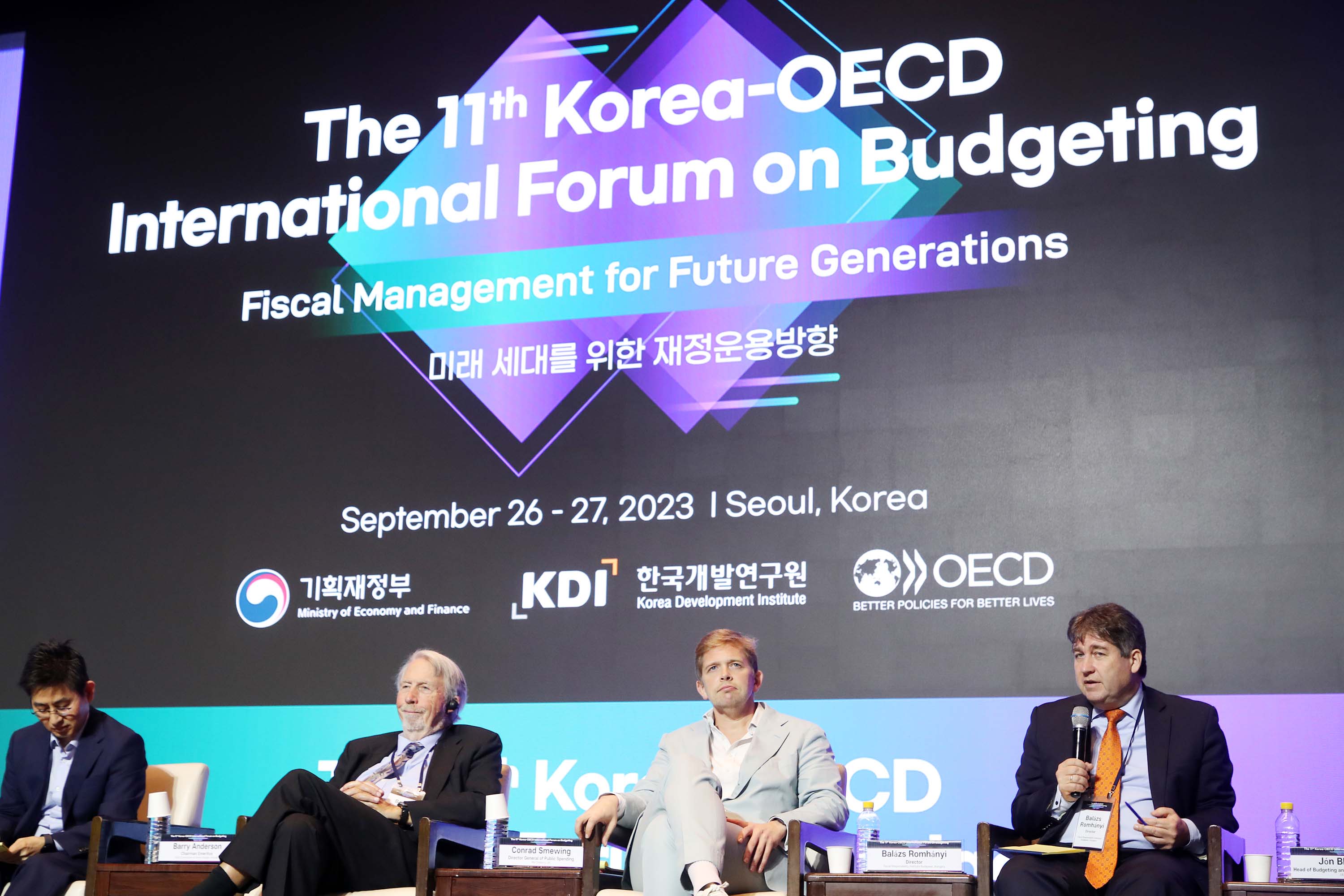
The following day, Jon Blondal, Head of Budgeting and Public Expenditures at the OECD, presented key discussion topics regarding revenue generation, expenditure restructuring, targeting public expenditures, and performance measurement as responses to the increasing expenditure burden. He also introduced the OECD Spending Better Framework. Importantly, Mr. Blondal emphasized the need for budget organizations to approach fiscal issues from a macro perspective, independently, and to promote public understanding to bolster the resolve to address fiscal issues. Subsequently, in-depth discussions among budget officials and fiscal experts from various countries took place.
This forum was livestreamed online through YouTube, and it witnessed significant interest and anticipation from various government agencies, academia, and the general public who attended both online and offline. The forum contributed to shaping the direction of fiscal management for future generations, focusing on improving fiscal soundness and effectiveness, overcoming the climate crisis, and sharing experiences and expertise from major countries. It is expected to contribute to national debt relief, increased fiscal efficiency, and achieving carbon neutrality by concretizing the approach to fiscal management for future generations.
We reject unauthorized collection of email addresses posted on our website by using email address collecting programs or other technical devices. To access the email address, please type in the characters exactly as they appear in the box below.
Please enter the security code to prevent unauthorized information collection.