
News 「The Future of Work: A New Labor Market in Coexistence with AI」 Policy Forum Held
「The Future of Work: A New Labor Market in Coexistence with AI」 Policy Forum Held
「The Future of Work: A New Labor Market in Coexistence with AI」
Policy Forum Held
-
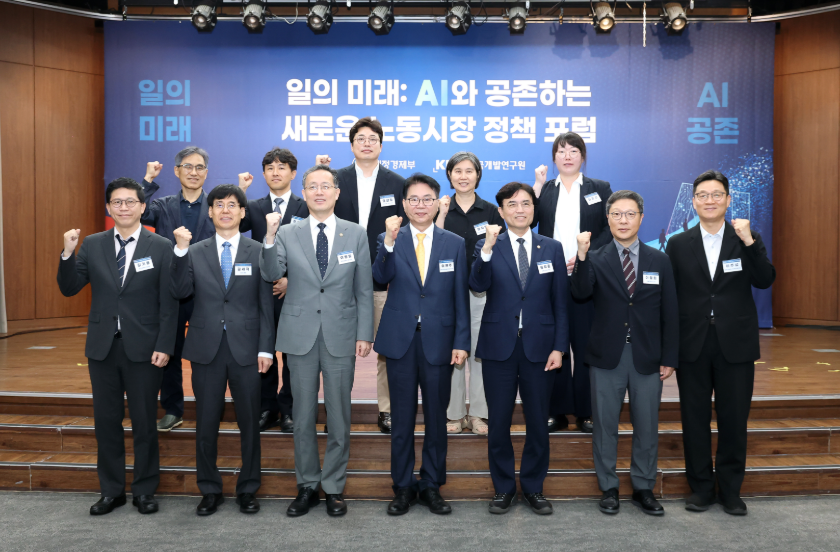
KDI and the Ministry of Finance and Economy jointly hosted the Policy Forum on “The Future of Work: A New Labor Market in Coexistence with AI” on July 9 (Thursday), 2026, at the International Conference Room of the Korea Federation of Banks. The forum was organized to assess the impact of the rapid advancement of artificial intelligence (AI) technology on labor market participants and to explore policy directions for a new labor market that coexists with AI.
[Opening Ceremony]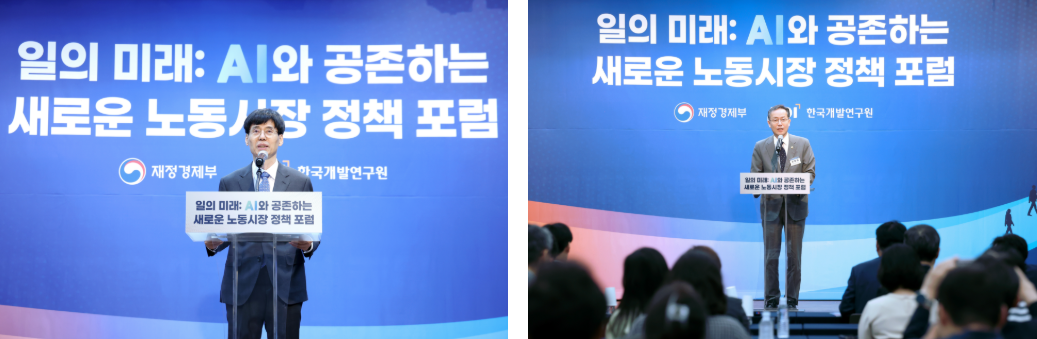
KDI President Se-Jik Kim said in his opening remarks that the ongoing shift in how AI technology is transforming the way we work is not a passing technological trend, but a structural change that is fundamentally reshaping the labor market, industrial structure, and ultimately the growth foundation of the Korean economy. Noting that the Korean economy has faced declining long-term growth for more than three decades, President Kim said AI could either deepen this trend or, conversely, become a new opportunity for growth, adding, “Ultimately, success in the AI era will depend less on AI itself and more on how well we prepare and how wise the policies and institutions we put in place are.” He further stressed that, especially in the AI era, it is critical to cultivate creative human capital and build a labor market and policy support system capable of adapting flexibly to change.
First Vice Minister Hyung-il Lee of the Ministry of Finance and Economy said in his congratulatory remarks that the world is rapidly evolving toward an era of agentic AI — AI that sets its own goals and coordinates tasks — posing the dual challenge of a fundamental innovation in how we work and a structural shift in the labor market. Vice Minister Lee said the government would actively support the training of talent in response to changing labor market demand and strengthen the employment safety net in order to turn the AI transformation into an opportunity rather than a crisis, while systematically preparing workforce-development plans for new industries that reflect national investment needs such as the three mega projects.
[Keynote Speech: AI, Basic Society, and the Future of Labor]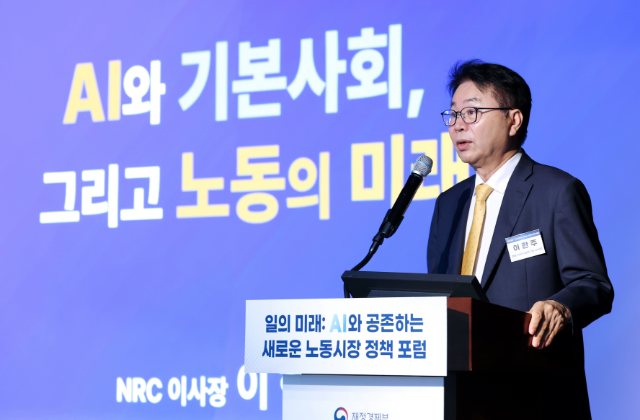
Speaking on “AI, Basic Society, and the Future of Labor,” Chairperson Han-joo Lee of the National Research Council for Economics, Humanities and Social Sciences (NRC) observed that AI stands at a crossroads foretelling two opposing futures — ‘astonishing abundance’ and ‘retrotopia’ — and diagnosed that “the gains from AI productivity are not automatically distributed.” Chairperson Lee explained that, unlike past technological shocks, this AI shock is spreading from the top down, reaching even professional occupations that require cognition and judgment. As a solution, he proposed a ‘basic society’ model premised on universal rights rather than labor market participation, suggesting that financial and learning basic rights be expanded to substantively realize the constitutional rights to pursue happiness and to a life worthy of human dignity.
[Presentations: Questioning the Future of Work in the AI Era]
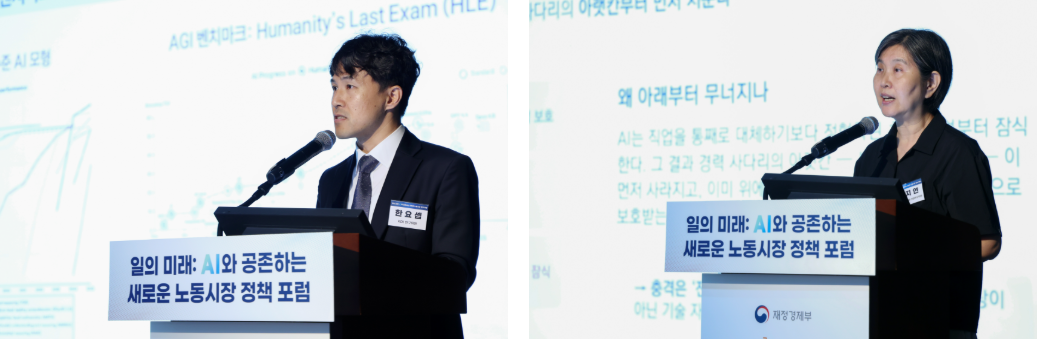
Presenting on “The Labor Market in the AI Era: Assessment and Outlook,” KDI Fellow Joseph Han noted that individual adoption of AI is spreading faster than any past technology, yet actual usage still falls short of its potential, while corporate AI adoption is accelerating mainly among large firms and knowledge-based service industries, widening the gap by firm size and industry. Fellow Han forecast that as the task-performing capabilities of AI and robots expand, more than 90 percent of tasks in over 90 percent of current jobs could be technically automated by 2030, and stressed the need for buffers such as employment-friendly AI-transformation support for small and medium-sized enterprises, expanded internal flexibility at mid-sized and large firms, and regular labor-management consultations on technology adoption, in order to reduce the likelihood of abrupt restructuring. He also suggested the need to accelerate the creation of new tasks and occupations and to strengthen the flexibility and practicality of education.
Presenting on “How Does AI Change Employment?: Empirical Evidence and Institutional Responses,” Korea Labor Institute (KLI) Senior Fellow Jiyeun Chang emphasized that while technology determines the occurrence of AI-driven employment shocks, institutions determine how they are distributed, so policy should focus not on the technology itself but on designing how the shock is distributed. Senior Fellow Chang pointed out that AI is a seniority-biased technology that first erodes standardized, entry-level tasks, concentrating its impact on young people and new entrants — manifesting not as ‘layoffs’ but as ‘blocked entry.’ In response, she proposed that policy be designed to bring the younger generation into the system across three dimensions: ‘distribution,’ which diversifies the funding base for social security; ‘governance,’ which includes young people in decision-making processes; and ‘skills and entry,’ which includes an integrated skills-demand diagnosis system and the introduction of national competency accounts.
[Panel Discussion]
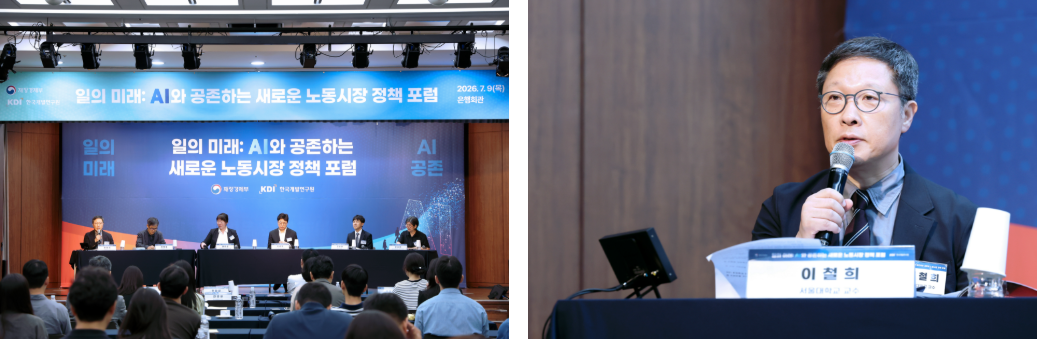
Following the presentations, a panel discussion was held, moderated by Professor Chulhee Lee of Seoul National University (SNU).
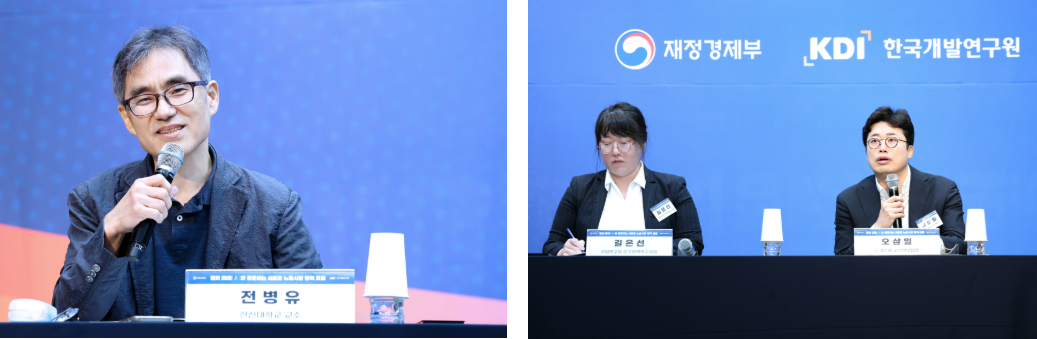
Sam-il Oh, Head of the Employment Research Team at the Bank of Korea (BOK), said that although AI is spreading far faster than past technologies or in major advanced economies, its effects have yet to show up clearly in macro indicators such as employment or productivity. He noted, however, that negative effects are relatively evident among young people, suggesting this could be a transitional phenomenon in the early stage of technology adoption. Citing a Bank of Korea survey, he said individual workers’ working hours have fallen due to AI, but this has not translated into higher output, which he attributed to the fact that how employees work and how firms are organized have yet to change, underscoring the need to redesign work processes and organizational structures and to build performance-based incentive systems.
Professor Byung You Cheon of Hanshin University argued that a time lag still exists between what AI is technically capable of doing and what is actually adopted and implemented, and that the issue of youth employment should be approached as a matter of the ‘career ladder’ rather than ‘employment volume.’ He pointed out that entry-level tasks traditionally assigned to new hires are the first to be replaced by AI, even though these tasks have also served as a training ground where the next generation develops practical judgment and skills; if such opportunities diminish, the cost of skills transmission could spill over onto society as a whole as an externality. He suggested that policy should shift its axis from firm-led training toward an individual-led lifelong training system that builds skills that move with the individual rather than skills tied to a specific job.
Eunsun Gil, Director of the Population Strategy Research Office at the Korea Institute for Industrial Economics & Trade (KIET), agreed with the other panelists that the evidence so far does not universally confirm the pessimistic outlook that AI will cause large-scale unemployment in the short term, but said that special policy attention is needed for young people, whose opportunities to build early career experience are weakening due to reduced new hiring and fewer entry-level tasks. She stressed that since productivity gaps in the AI era stem more from firms’ management strategies and capacity to redesign work than from the technology itself, public policy should be designed not around whether AI is adopted but around encouraging firms to adopt employment-friendly, productivity-enhancing utilization strategies.
We reject unauthorized collection of email addresses posted on our website by using email address collecting programs or other technical devices. To access the email address, please type in the characters exactly as they appear in the box below.
Please enter the security code to prevent unauthorized information collection.