
News KDI-OECD DEV Joint Seminar on Climate Transition, Resilience and Development Cooperation
KDI-OECD DEV Joint Seminar on Climate Transition, Resilience and Development Cooperation
KDI-OECD DEV Joint Seminar on Climate Transition,
Resilience and Development Cooperation
-
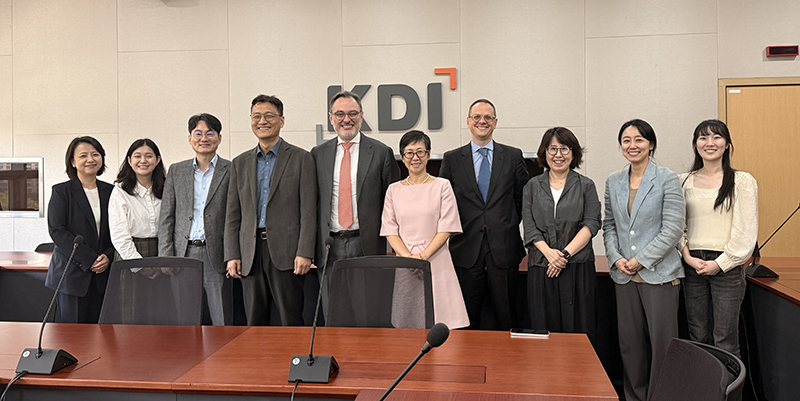
On September 16, 2026, the KDI Center for International Development (CID), in collaboration with the OECD Development Centre (DEV), held the KDI–OECD DEV Joint Seminar at KDI under the theme “Climate Transition, Resilience and Development Cooperation.” The seminar was organized to examine the economic and social challenges facing developing countries as they seek to respond to climate change while achieving sustainable economic growth amid intensifying climate risks and an accelerating transition toward a low-carbon economy, and to discuss the role of international development cooperation.
In his opening remarks, Jungwook Kim, Executive Director of the Center for International Development, KDI, emphasized the importance of connecting diverse stakeholders and research resources and identifying partners with whom ideas can be shared in addressing global challenges. He also expressed his hope that the seminar would go beyond a one-off event and lead to continued exchanges among researchers.
Federico Bonaglia, Deputy Director of the OECD Development Centre, emphasized that the green transition should take into account countries’ different stages of development and national circumstances, rather than applying a uniform approach to all countries. He further stressed that policy discussions should be grounded in evidence-based analysis to identify sustainable development pathways suited to each country’s circumstances.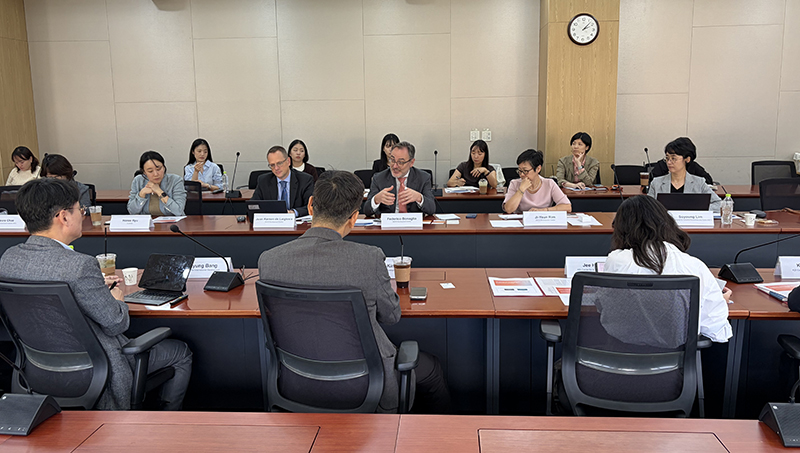
Session 1: Climate Change and Green Transition: Economic and Social Implications for Developing Countries
Hokyung Bang, Director of the Development Research Division, CID, KDI, presented “The Impacts of Climate Change on Inflation and Productivity in Developing Countries: Implications for International Development Cooperation.” He examined the effects of climate change on inflation and productivity in developing countries and showed that these effects can vary depending on a country’s climate readiness. He also emphasized that international development cooperation should place greater emphasis on ex-ante adaptation and resilience building, rather than focusing primarily on post-disaster recovery.
Ji-Yeun Rim, Senior Policy Analyst in the Climate and Development Unit at the OECD Development Centre, presented “Social Implications of the Green Transition in Southeast Asia.” She examined the vulnerability of environment-related jobs and agriculture and food systems in Southeast Asia to climate change. Highlighting the particular vulnerability of workers with lower levels of education, informal workers, and farming households, she stressed the need to strengthen the resilience of agriculture and food systems and promote an inclusive green transition.
Soyoung Lim, Head of the Global Industrial Cooperation Research Division at the Korea Institute for Industrial Economics and Trade (KIET), noted that, in addition to the physical risks of climate change addressed in the two presentations, greater attention should be paid to transition risks, including workers’ movement across sectors and changes in industrial structure during the green transition. She also emphasized that development cooperation should move beyond responding to climate shocks after they occur and support developing countries in ex-ante adaptation, resilience building, and green structural transformation.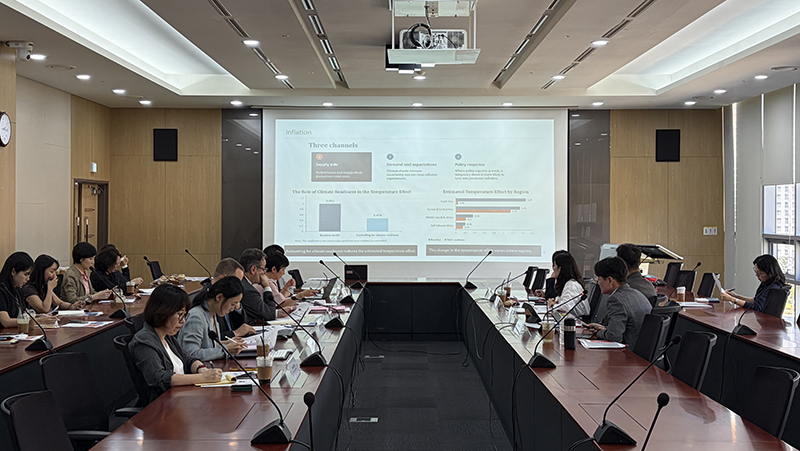
Session 2: Carbon Emissions Pricing and Energy Subsidy Reforms: Implications for Developing Countries
Juan Ramón de Laiglesia Lorenzo, Senior Economist in the Country Diagnostics and Strategy Unit at the OECD Development Centre, presented “Energy Subsidies and Prices: What We Know About Reform and How to Make It Happen.” He explained that fossil fuel subsidies can distort energy prices, increase fiscal burdens, and disproportionately benefit higher-income households. He stressed that successful subsidy reform requires gradual price reform, compensation for vulnerable groups, stakeholder consultation, and integrated policy design across government ministries.
Jee Hee Yoon, Chief of the Division of Development Research, CID, KDI, presented “Impact of EU CBAM on the Asia-Pacific Region: Policy Implications for Regional Cooperation.” She analyzed how the effects of the EU Carbon Border Adjustment Mechanism (CBAM) can vary across countries and industries depending on their reliance on the EU market and the carbon intensity of production. She emphasized the need to use carbon pricing and low-carbon technology support in a complementary manner, while strengthening technology diffusion, finance and international cooperation, and Measurement, Reporting and Verification (MRV) capacity.
Yeora Chae, Senior Research Fellow at the Korea Environment Institute (KEI), stressed that improving the effectiveness of carbon mitigation policies requires a dynamic assessment of the Social Cost of Carbon (SCC) and marginal abatement costs, taking into account evolving climate risks and technological change. She also highlighted the need for policy design tailored to country-specific circumstances and more advanced analysis using diverse data sources.
Hanee Ryu, Director at EcoBrain, emphasized the need to assess support policies in the electricity sector by disaggregating them according to the objectives of each stage of the value chain, including fuel procurement, generation, transmission and distribution, and retail. She also noted that as carbon regulations become more sophisticated, the importance of emissions accounting and MRV capacity that reflect time, location, and supply-chain characteristics will continue to grow.
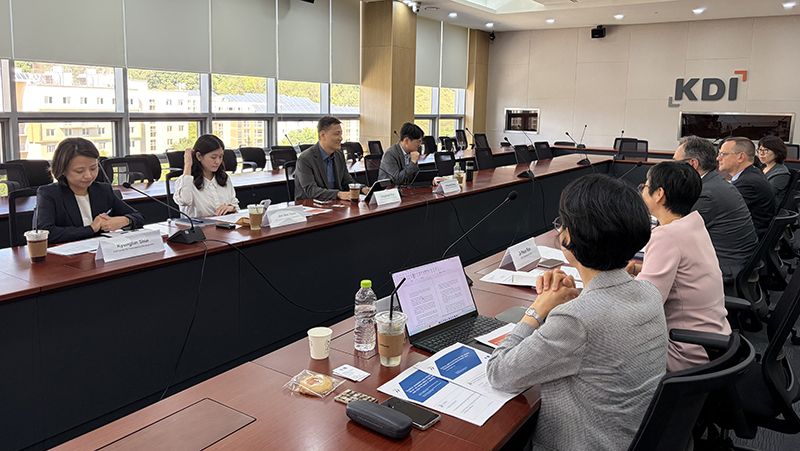
Building on the KDI–OECD DEV Joint Seminar, the two institutions explored opportunities for future research collaboration and cooperation in the areas of climate change, development, and sustainability, and agreed to continue strengthening policy dialogue and exchanges in these areas.Written by: Sohee Kim, Research Associate, Division of Development Research, Center for International Development (CID), 044-550-4401, sohee.kim@kdi.re.kr
We reject unauthorized collection of email addresses posted on our website by using email address collecting programs or other technical devices. To access the email address, please type in the characters exactly as they appear in the box below.
Please enter the security code to prevent unauthorized information collection.