
News 2026 G20 Global Financial Stability Conference Successfully Held
2026 G20 Global Financial Stability Conference Successfully Held
2026 G20 Global Financial Stability Conference
Successfully Held

The Ministry of Finance and Economy (MOFE) and the Korea Development Institute (KDI) hosted the 2026 G20 Global Financial Stability Conference on October 27 at the Four Seasons Hotel Seoul.
The conference brought together policymakers, representatives of international organizations, academics, and economic and financial experts to examine the implications of major structural changes—including geopolitical tensions, rising global debt, artificial intelligence (AI) innovation, and supply chain reconfiguration—for the global economy and financial stability.
With 318 participants, the conference provided a platform for in-depth discussions on global economic resilience, emerging financial risks associated with AI, and the real-economy and financial implications of supply chain fragmentation.

[Opening Ceremony]
The conference opened with remarks by Chang Huh, Second Vice Minister of MOFE, and Se Jik Kim, President of KDI.
Second Vice Minister Huh outlined three policy priorities for addressing interconnected global risks: strengthening financial risk management frameworks for AI, balancing fiscal sustainability with investment in future growth, and establishing a dual safety net encompassing both financial stability and supply chain resilience.
President Kim emphasized that financial stability in an era of structural transformation requires systems capable of absorbing unexpected shocks while maintaining their essential functions. Looking ahead to Korea’s G20 Presidency in 2028, he reaffirmed KDI’s commitment to developing practical policy ideas through collaboration with international organizations and research institutions.


[Keynote Addresses]
The keynote addresses were delivered by Markus Brunnermeier, Professor of Economics at Princeton University, and Laura Alfaro, Chief Economist and Economic Advisor at the Inter-American Development Bank (IDB).
Professor Brunnermeier examined how AI could fundamentally reshape financial markets and central banking. He argued that traditional financial frictions arising from asymmetric information may increasingly give way to “asymmetric understanding,” in which AI agents possess analytical capabilities that human market participants and regulators cannot fully comprehend. Highlighting risks associated with the limited explainability of AI models and their complex interactions, he called for simpler and more robust regulatory approaches, greater interoperability among AI models, and stress testing that accounts for technological dependence and concentration risks.
Professor Alfaro presented research on U.S. external imbalances through the lens of multinational enterprise ownership and global production networks. While acknowledging the conventional macroeconomic explanation of trade imbalances through saving and investment, she emphasized the importance of understanding the firms whose production and sourcing decisions generate trade flows. Her findings showed that intra-firm trade by U.S. multinationals is broadly balanced, while foreign-owned multinationals and domestic firms account for much of the U.S. goods trade deficit. She also argued that global supply chains are being reallocated rather than simply dismantled, underscoring the critical role of sound banking systems in financing firms’ adjustments to trade and policy shocks.


[Session 1 | Global Economic Resilience and Financial Stability]
Chaired by Joon-Ho Hahm, Professor at Yonsei University, Session 1 addressed emerging vulnerabilities in global financial markets and challenges associated with elevated debt levels.
Felix Suntheim, Deputy Division Chief at the International Monetary Fund (IMF), explained that nonbank financial intermediaries (NBFIs) contribute to market liquidity and international risk sharing but can also amplify shocks through liquidity mismatches, leverage, and crowded investment positions. He highlighted the growing sensitivity of emerging-market portfolio flows to changes in global risk conditions.
Ayhan Kose, Deputy Chief Economist at the World Bank Group, presented historical evidence on public debt reduction, emphasizing strong economic growth as a common feature of successful debt reduction episodes. He stressed the importance of credible medium-term fiscal frameworks, productivity-enhancing reforms, and sound debt management.
Discussants Meeroo Kim of KDI and Kwanho Shin of Korea University emphasized the need for system-wide stress testing, careful interpretation of the relationship between growth and debt reduction, and an integrated assessment of public and private debt vulnerabilities.

[Session 2 | Financial Stability Risks and Policy Challenges from AI Innovation]
Chaired by Seung Jung Lee of the Federal Reserve Board, Session 2 examined the implications of AI adoption for economic growth and financial stability.
Tomoyuki Shimoda, Professor at Rikkyo University, discussed how AI could reshape productivity, international trade, and comparative advantage while widening economic disparities between countries that provide AI services and those that primarily consume them. He highlighted the potential of physical AI for manufacturing-based economies such as Korea and Japan, while warning that a gap between expected and realized productivity gains could create financial vulnerabilities.
Fatos Koc, Head of the Financial Markets Unit at the Organisation for Economic Co-operation and Development (OECD), examined the growing cyber risks associated with AI deployment. She emphasized that vulnerabilities can spread across financial institutions through third-party technology providers and shared digital infrastructure. Rather than creating entirely new regulatory regimes, she highlighted the importance of reinforcing existing risk-based supervisory frameworks, improving preparedness, and strengthening public-private and international cooperation.
Discussants Sungzoon Cho and Haksoo Ko of Seoul National University explored the organizational and industrial transformations required to realize AI’s benefits, the implications for workforce development, and the importance of effective governance in managing cyber risks.

[Session 3 | Financial Stability Risks and Policy Challenges from Supply Chain Fragmentation]
Chaired by Tatiana Rosito, Division Director at the World Bank Group, Session 3 explored the economic and financial consequences of supply chain reconfiguration and the need for international policy cooperation.
Sébastien Miroudot, Acting Head of Division at the OECD, emphasized that global trade and value chains have remained resilient despite geopolitical tensions. However, he noted that greater resilience has not necessarily been accompanied by geographical diversification. He warned that the concentration of critical mineral supplies and increasing export restrictions could exacerbate commodity price volatility.
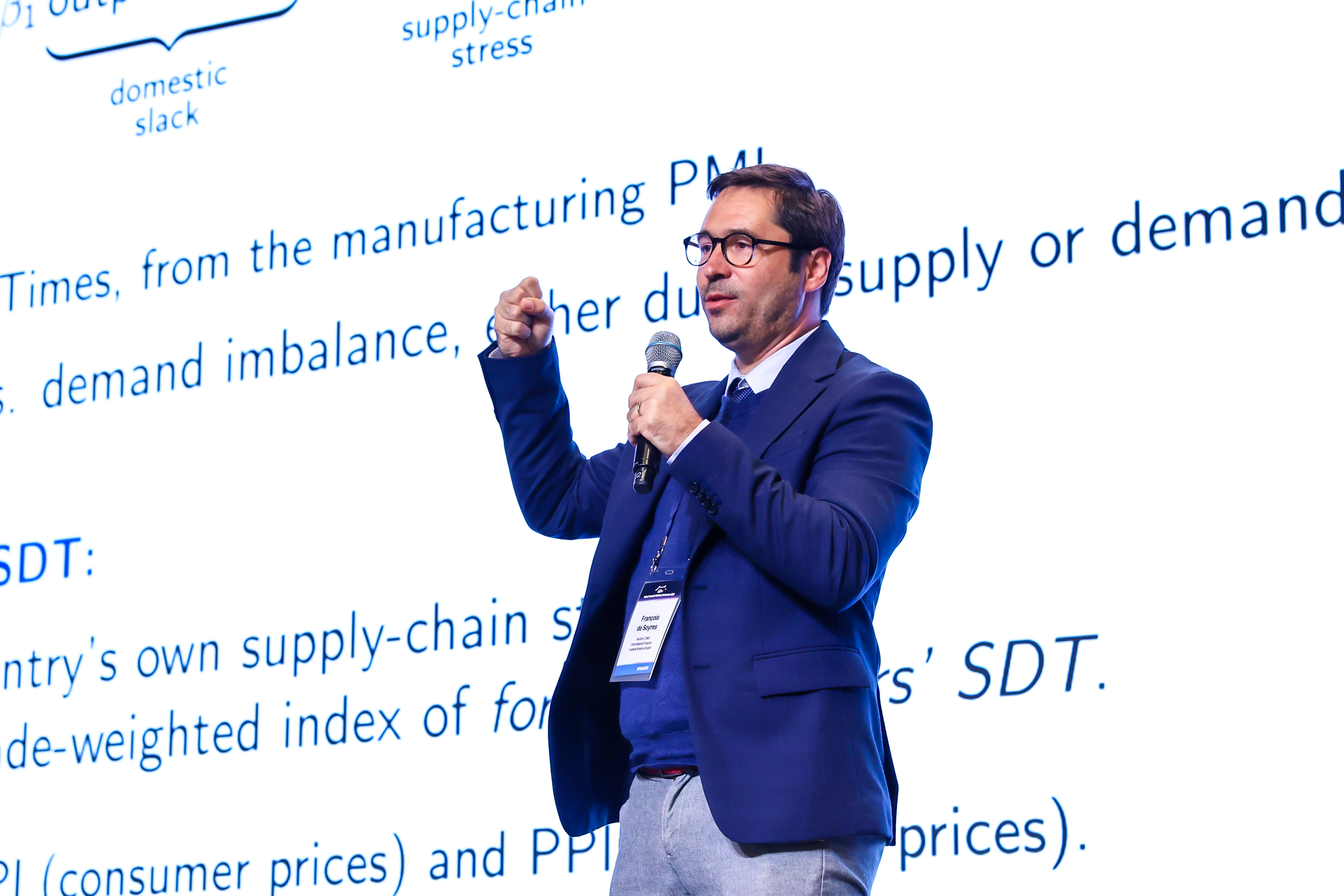
François de Soyres, Section Chief at the Federal Reserve Board, examined how trade in intermediate inputs deepens economic interdependence across countries. He presented evidence that supply chain pressures are increasingly associated with domestic inflation and that participation in global value chains can alter the traditional role of exchange rates in absorbing external shocks.
Discussants Eunhee Lee and Jaemin Lee of Seoul National University addressed the uneven distribution of costs and benefits arising from supply chain reconfiguration, its implications for income distribution, and the growing fragmentation of international trade rules.

[Overall Assessment]
The conference highlighted how AI innovation and supply chain transformation are reshaping the sources and transmission channels of financial stability risks. Across the sessions, participants emphasized the importance of international policy dialogue, stronger data collection and risk surveillance, and policy approaches that consider financial stability and supply chain resilience together.
As Korea prepares for its G20 Presidency in 2028, the conference provided valuable insights for identifying future policy priorities and strengthening international cooperation on global financial stability.

Written by: KIM, Daeyong, Specialist, Office of Global and North Korean Economic Studies, Korea Development Institute (KDI) Tel. +82-044-550-4165, Email: dykim@kdi.re.kr
We reject unauthorized collection of email addresses posted on our website by using email address collecting programs or other technical devices. To access the email address, please type in the characters exactly as they appear in the box below.
Please enter the security code to prevent unauthorized information collection.