|
What's Up Monthly
May 19, 2026 | vol. 33
|
|
In today's newsletter:
- KDI Economic Outlook: 2026-1st Half
- Special Conference with Nobel Laureate Peter Howitt Explores New Paradigms for Growth
- GKEDC - EBRD Knowledge Sharing on Social Infrastructure PPPs with Focus on Student Housing
- KDI-World Bank Planet Vice Presidency Joint Session and MOU Signing Ceremony
|
 |
|
KDI Economic Outlook: 2026-1st Half
The Korean economy is projected to grow by around 2.5% in 2026 — surpassing its potential growth rate and entering an expansionary phase — driven by a semiconductor export boom and recovering domestic demand. Growth is expected to moderate to approximately 1.7% in 2027.
Key Projections
- GDP Growth: Projected at around 2.5% in 2026 and about 1.7% in 2027.
- Private Consumption: Projected to rise by around 2.2% in 2026 and 1.5% in 2027, supported by improving income conditions and government support measures.
- Equipment Investment: Expected to expand by around 3.3% in 2026 and 2.4% in 2027, supported by robust investment demand from the semiconductor upturn.
- Construction Investment: Projected to increase by 0.1% in 2026 as higher construction costs stemming from the war in the Middle East delay its recovery, before rising to around 1.1% in 2027.
- Exports: Expected to increase by around 4.6% in 2026, supported by the semiconductor upcycle, and to maintain solid growth of around 2.2% in 2027.
- Current Account: Projected to post a large surplus of $239.0 billion in 2026 and $213.7 billion in 2027, driven by a sharp increase in semiconductor exports.
- CPI Inflation: Forecast to rise to around 2.7% in 2026, as higher international oil prices coincide with the recovery in economic activity, before moderating to about 2.2% in 2027.
- Employment: Expected to continue improving gradually, with the number of employed persons increasing by 170,000 in both 2026 and 2027 as domestic demand recovers.
Policy Directions for 2026-27
- Monetary Policy: Demand-side inflationary pressures are building as private consumption improves, while higher international oil prices have added to supply-side pressures, risking destabilized inflation expectations. Amid ongoing external uncertainties like the war in the Middle East, monetary policy needs to respond flexibly and prudently to guard against these risks and a potential deviation from the inflation target.
- Fiscal Policy: Fiscal policy should focus on raising potential growth and supporting income-vulnerable groups, while continuing efforts to improve spending efficiency. As mandatory expenditures—including basic pensions and local education finance grants—expand significantly, active institutional reforms are required. Specifically, basic pension support should better target vulnerable older persons, and education grants should be restructured to reflect the school-age population.
|
|
|
 |
|
Special Conference with Nobel Laureate Peter Howitt Explores New Paradigms for Growth
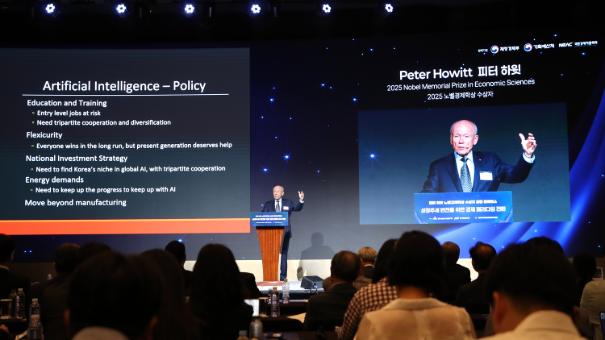
On May 15, KDI and the NRC co-hosted a special conference titled “Shifting the Economic Paradigm to Reignite Growth.” The event featured a keynote presentation by Professor Peter Howitt, the 2025 Nobel Laureate in Economic Sciences, who shared insights on "The Path for Korea’s Innovation-led Growth in the Age of AI and Robotics." Drawing on Schumpeterian theory, Professor Howitt emphasized the shift from a catch-up model to a frontier economy, followed by an in-depth dialogue with Joonkyung Ha, Senior Secretary for Economic Growth.
The subsequent sessions focused on diagnosing structural bottlenecks and discussing directions for reform. Experts from Hyundai Motor Group, Korea University, and KDI presented on productivity and corporate growth policies, highlighting the need to reinvent Korea's innovation system. The conference concluded with a high-level panel discussion, moderated by KDI President Se-Jik Kim, where top policymakers and scholars explored the institutional foundations and government roles necessary to foster creative destruction.
?? Missed the Live Event?
The entire session, featuring vital discussions and key insights from Nobel Laureate Peter Howitt, is fully recorded and available for your review. We invite you to access the complete recording via the [YouTube Live Stream Link].
- Discover Program Details
- Access Presentation Slides
|
 |
|
GKEDC - EBRD Knowledge Sharing on Social Infrastructure PPPs with Focus on Student Housing
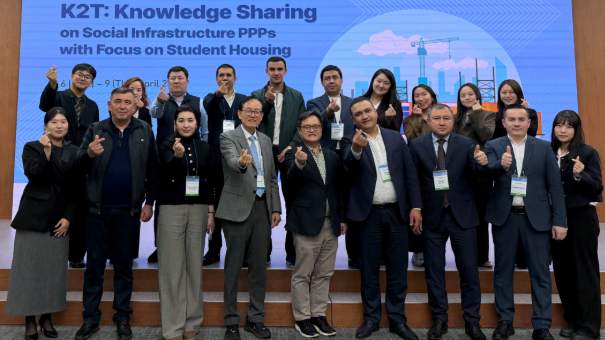
From April 6 to 9, 2026, KDI GKEDC and the EBRD hosted a capacity-building program on social infrastructure PPPs for an Uzbekistani delegation of government officials and university vice-rectors. The program featured expert lectures on Korea's PPP frameworks and university dormitory models, complemented by site visits to Seoul National University and Korea University. This joint initiative provided the delegation with actionable insights for Uzbekistan's student housing projects while reinforcing international cooperation for sustainable infrastructure development.
|
|
|
 |
KDI-World Bank Planet Vice Presidency Joint Session and MOU Signing Ceremony Held
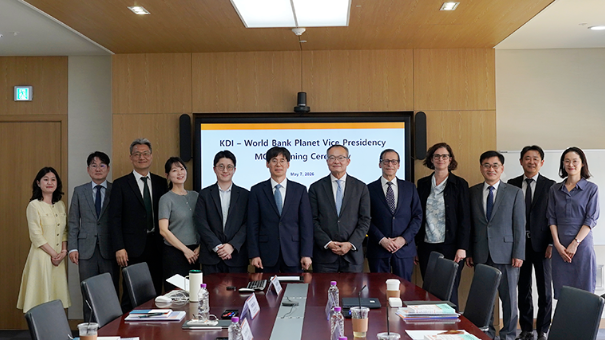
On May 7, 2026, KDI hosted a joint session and signed a Memorandum of Understanding (MOU) with the World Bank Planet Vice Presidency to strengthen cooperation on global development agendas, including climate change, the environment, and sustainable development. During the event, experts from both institutions shared critical research insights on climate market designs, carbon neutrality, and the economic impacts of environmental crises. Building on this new partnership, KDI and the World Bank will actively pursue joint research, seminars, and knowledge-sharing programs to address pressing global challenges and foster sustainable growth worldwide.
|
|
|
|