
Dialogue on the North Korea Economy North Korean Statistics and Research on the North Korean Economy April 21, 2021
Dialogue on the North Korea Economy
North Korean Statistics and Research on the North Korean Economy
April 21, 2021 For researchers who study the North Korean economy, one of the most unknown and interesting areas is North Korean statistics. There are many questions such as: Do statistics on the North Korean economy even exist? If not, how do overseas researchers conduct their studies? and If so, can we trust them? What statistics are published by the South Korean government and other global institutions? The list goes on, but no one has come up with a conclusive answer.
This is why we chose North Korean statistics as the first topic of the new series. Numerous questions were dealt with on the topic and their significance for studies on the North Korean economy. We hope you find this article useful and informative.

This is why we chose North Korean statistics as the first topic of the new series. Numerous questions were dealt with on the topic and their significance for studies on the North Korean economy. We hope you find this article useful and informative.
♦ Date and Venue: KDI meeting room, Tuesday, April 28, 2020
♦ Interviewer: Cho, Byungkoo (Senior Fellow at KDI)
♦ Interviewee: Lee, Suk (Senior Fellow at KDI)
Before we begin, I would like to thank Dr. Lee, Director of the KDI Office of North Korean Economic Studies, for his participation. To lead us off, let us examine the statistics from and research on North Korea. So, Dr. Lee, what are your thoughts on North Korean statistics? Contrary to the general opinion that there is no such thing, do they exist or are we, the outside world, simply unaware? Also, if they do exist, how has ‘availability’ changed over time?
First and foremost, it is an honor to be the first interviewee for the new Dialogue series. It is especially meaningful that you, Dr. Cho, my predecessor, are conducting this interview. Although I have talked about North Korean statistics on many occasions, I will dive deeper into the issue today, and offer more details.
To your first question about the existence of North Korean statistics, the most accurate answer would be “sometimes.” In other words, it is erratic and depends on the circumstances and point in time. To present a clearer picture, we need to divide by period. There are a total of four phases: the first starts from Korea’s liberalization from Japan in 1945 to 1960; the second is from 1961 to the end of the 1980s; the third from 1990 to 1995; and the last is from 1996 onwards.
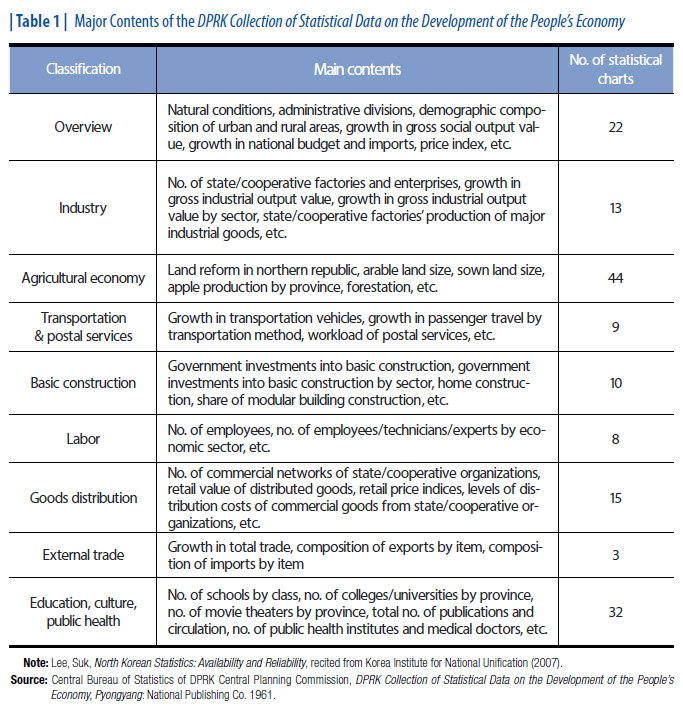
The second aspect is that statistics were a part of all official statements. General-ly, a socialist state is governed not through law but through orders. These orders were called “cabinet decrees” in North Korea, and most included statistics. For instance, the cabinet decrees aimed at concentrat-ing the buying and selling of cereals on the central authorities to sustain its food rationing system in the 1950s included re-gional crop statistics. This is only one ex-ample, and in fact, statistics were incorpo-rated into other official documents such as the ‘People’s Economic Development Plan,’ North Korea’s first economic plan under the banner of socialism, and statements from high-level meetings, including the Su-preme People’s Assembly.
"although the period from 1945 to 1960 was certainly not bountiful, statistics on a wide-range of areas were regularly published in North Korea."
As you can see, although the period from 1945 to 1960 was certainly not boun-tiful, statistics on a wide-range of areas were regularly published in North Korea. And, these figures have enabled the outside world to, at least in part, conduct their re-search on the North Korean economy. In fact, Dr. Chung, Sang-hoon’s research in the 1970s used statistics that had been released up until the 1960s. As far as I know, the study was the first earnest attempt in the field.
 Before we go any further, you say that statistics existed in North Korea until 1960, but are they the same as what we know them to be today?
 Good question. The statistics produced in North Korea at that time were quint-essentially socialist, so they vastly differ from our general understanding of statis-tics. This can be illustrated in many ways, but I will give you one example that will be easier to understand. Most statistics we see today are physical statistics. That is, if 1.28 million tons of steel were produced in South Korea in 1961, then, 1,280,000 would be recorded as the steel output and the fig-ure would be announced as the official sta-tistic. A socialist economy, however, also uses other methods. The most typical is the index number. Say, 1950 is set as the base year and the amount of steel produced is 100, then the steel output for 1960 would be announced as 123. There is also the growth rate. For instance, a statement from a so-cialist state would say, “Steel production in 1957 grew 53% compared to 1950.” Of course, we could infer the physical statistics from both if the accurate physical statistics for the base year (1950) were available.
"From the early 1960s until the end-1980s, he authorities did not publish any statistics at all. This period is often called the ‘statistical blackout.'"
Unfortunately, in the case of North Ko-rea, the physical statistics for the base year were rarely published. Also, the base years for the index numbers and growth rates frequently changed. For example, the base year for 1960 would be set at 1950, but that for 1961 would be set at 1955. So, although we have the statistics up until 1960, it is impossible for us to retrieve a complete time-series dataset. There are other serious issues like the fact that, in most cases, there are no physical statistics. As to why North Korea would use such methods, I would think it is because, on the one hand, it wants to show off its seemingly rapid eco-nomic growth both internally and exter-nally, and on the other, to conceal the eco-nomic realities. Although, this phenonenon is not limited to North Korea and can be found in other past socialist economies, such as the Soviet Union.
Your insight into North Korean statistics, or rather socialist statistics, is very intriguing. Then, what about after 1960?
Although statistics were regularly pub-lished between 1945 and 1960, they disap-peared from the Korean Central Yearbook in the early 1960s. They gradually stopped appearing in official documents after the Korean War, and then, all but disappeared by the end of the 1950s. From the ear-ly 1960s until the end-1980s, the authorities did not publish any statistics at all. This pe-riod is often called the ‘statistical blackout.’ The absence of statistics, of course, hin-dered research on the North Korean econ-omy, and created the general perception that statistics do not exist in North Korea. However, from the perspective of us re-searchers, we were able to base our studies on three exceptions.
The first exception is the statistics com-piled and published by the South Korean government. There was a demand for sta-tistical data on the North Korean regime to conduct research and so, efforts were made on two fronts. Firstly, the Board of National Unification, the predecessor of the Ministry of Unification, began gath-ering and organizing quasi-statistics from North Korean media reports and oth-er available sources. Let’s assume that in his 1975 New Year’s address, Kim Il-sung announced that “Last year, our people achieved a dazzling accomplishment in the battle to meet the harvest goal of 7 million tons of grain.” Then, the Board presumes that North Korea’s grain production for 1974 was roughly 7 million tons. Of course, this is not statistics in the general sense of the word because we are unable to confirm whether the accurate figure is 6.99 million tons, 7.01 million tons, or 7.15 million tons. Regardless, taking into account that these figures do contain some statistical infor-mation, they were compiled under sever-al categories such as gross macroeconom-ic output, industry, infrastructure, etc. The data were used by the Board in the 1990s to publish Collection of North Korean Economic Statistics.
For researchers of the North Korean economy, these publications are a pre-cious source of data for the blackout period. Apart from the Board, other rel-evant agencies in South Korea seem to have made similar efforts to systematical-ly gather information related to North Ko-rean statistics. With the belief that South Korea was in competition with the North in terms of regime, extensive efforts were made to evaluate North Korea’s econom-ic capabilities. During this process, vast amounts of statistical data on the North were required, and so, pertinent actions were taken. So, from our point of view, these endeavors serve as valuable stepping stones in our studies.

For more, please refer to the attached file.
related materials ( 9 )
- Key related materials
Security code
![captcha]()
We reject unauthorized collection of email addresses posted on our website by using email address collecting programs or other technical devices. To access the email address, please type in the characters exactly as they appear in the box below.
KDI Staff Information
Please enter the security code to prevent unauthorized information collection.
KDI Staff Information
KDI Staff Information