
Research Monograph Korean Real Estate Project Finance: Structure, Problems, and Policy Recommendations December 31, 2025
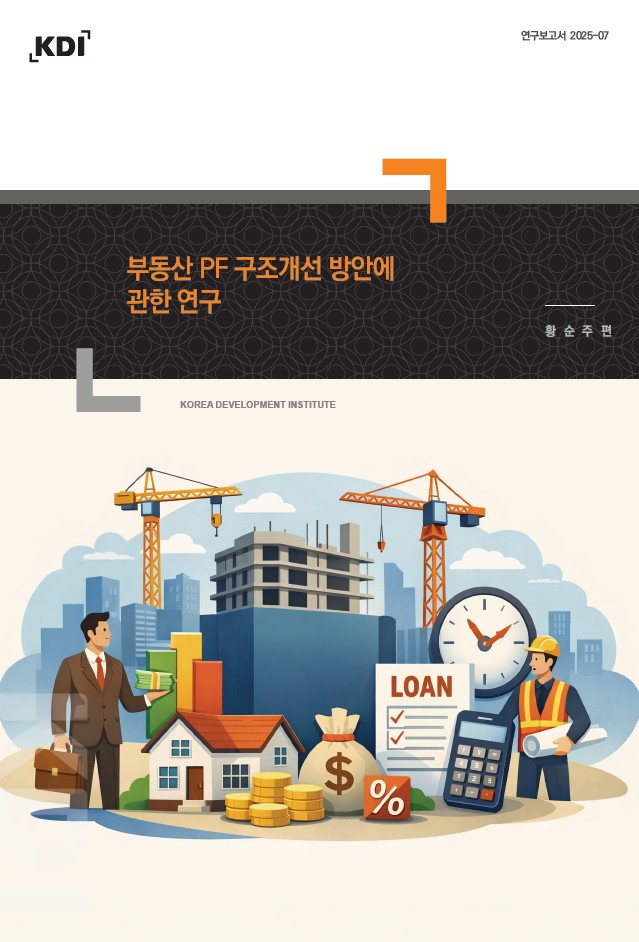
Series No. 2025-07
Research Monograph
KOR
Korean Real Estate Project Finance: Structure, Problems, and Policy Recommendations
#Corporte Finance
#Real Estate
#Financial Supervisory and Policy
December 31, 2025
-
Sunjoo Hwang
 프로필
프로필
- Summary
-
Since the 2022 Legoland crisis, real estate Project Finance (PF) has emerged as a significant risk factor for the entire South Korean economy, particularly within the financial and construction sectors. These crises are not isolated events but a phenomenon that recurs roughly every decade; for instance, the massive savings bank run of 2011 was also primarily driven by non-performing PF loans. The study addresses a set of fundamental questions: What are the root causes of these recurring PF crises, and how can they be resolved? What policy measures are available, what are their projected economic effects, and what are the key points of contention considering global precedents and Korea's unique institutional and industrial context? By conducting comprehensive institutional and empirical research, the study proposes structural improvements for real estate PF in Korea.
The study is organized into four chapters.
Chapter 1 explains the structure of real estate PF, diagnosing the "low-capital, high-guarantee" structure as the primary cause of these recurring crises, and discusses various policy measures to reform this structure. In major advanced economies, developers typically raise 20-40% of the total project cost as equity, but Korea's equity ratio stands at a mere 3%. Consequently, financial institutions rely on completion or payment guarantees from construction companies instead of rigorous project feasibility assessments. This chapter argues that this structure transfers risk to the entire society by encouraging reckless investment and system-wide instability. It then discusses policy recommendations such as tax deferrals on land contributions in kind to encourage equity expansion. Other related issues are examined, including equity loans―where developers borrow cash to fund their equity contribution―which critics argue can nullify the effect of equity increases. Policymakers may need to determine what constitutes qualified equity and what does not.
Drawing on a proprietary dataset of approximately 800 PF sites evaluated between 2013 and January 2025, Chapter 2 provides an in-depth empirical analysis of how low equity affects the soundness of PF projects. The analysis reveals that higher equity ratios significantly reduce pre-sale, financial, and construction risks. Furthermore, it demonstrates that higher equity ratios lead to lower total project costs, specifically in construction, financial, and miscellaneous expenses, suggesting that resolving the low-capital structure can improve both the stability of projects and the affordability of housing supply.
Chapter 3 complements the preceding chapter by analyzing site-specific PF data from the United States (via MSCI) to examine the relationship between financial structure and final project performance. The findings indicate that: (1) higher Loan-to-Value (LTV) ratios increase the probability of default; (2) higher LTV ratios reduce the likelihood of recovery after a default occurs; and (3) higher LTV ratios hinder post-completion transactions, such as refinancing into permanent loans or successful divestment (exit). Taken together, these results underscore that high debt dependency creates multifaceted risks throughout the project lifecycle.
Chapter 4 employs a Dynamic Stochastic General Equilibrium (DSGE) model to analyze the macroeconomic implications of PF regulatory changes. The model reflects Korea's unique "finance-real economy cross-structure," where non-bank financial institutions (NBFIs) provide about 70% of PF loans due to regulatory asymmetries. The analysis shows that while temporary tightening of capital requirements primarily causes credit reallocation between institutions, a permanent increase in NBFI capital requirements leads to long-term benefits. Although it may cause a temporary dip in housing supply, the accumulation of capital eventually improves credit supply capacity, leading to increased housing stock, stabilized prices, and higher total national output. In contrast, "cost-based" regulations that impose continuous costs on leverage were found to suppress credit supply and reduce aggregate production in both the short and long term.
- Contents
-
Abstract
Preface
Summary (Korean)
Chapter 1. Real Estate PF Issues: Diagnosis and Policy Measures for Institutional Improvement (Sehoon Bang and Soonjoo Hwang)
Section 1. Introduction
Section 2. Diagnosis of the Causes
Section 3. Policy Direction
Section 4. Review of Previously Announced Measures and the Need for Further Discussion
Section 5. Policy Recommendations
Section 6. Conclusion
References
Appendix
Chapter 2. The Effects of Equity Capital in Real Estate PF on Soundness and Supply Costs (Soonjoo Hwang)
Section 1. Introduction
Section 2. Current Status Analysis
Section 3. Empirical Analysis
Section 4. Conclusion
References
Chapter 3. The Effects of Debt Dependence on Risk in U.S. PF Projects and Implications for Korea (Seungrae Lee and Soonjoo Hwang)
Section 1. Introduction
Section 2. Previous Empirical Studies and Implications for Korea
Section 3. Overview of Real Estate Development Projects in the United States and Comparison with Korea
Section 4. Current Status Analysis
Section 5. Empirical Analysis
Section 6. Conclusion and Policy Implications
References
Appendix
Chapter 4. The Macroeconomic Effects of Real Estate Financial Regulation: Focusing on Its Impact on the Housing Market (Jiyoon Oh)
Section 1. Introduction
Section 2. Literature Review
Section 3. Model
Section 4. Calibration
Section 5. Results
Section 6. Conclusion
References
If you want to know more in detail?
related materials ( 9 )
- Key related materials
Security code
![captcha]()
We reject unauthorized collection of email addresses posted on our website by using email address collecting programs or other technical devices. To access the email address, please type in the characters exactly as they appear in the box below.
KDI Staff Information
Please enter the security code to prevent unauthorized information collection.
KDI Staff Information
KDI Staff Information