|
What's Up Monthly
September 23, 2025 | vol. 25
|
 |
Reforming the Basic Pension Eligibility Threshold
South Korea’s Basic Pension was created to address one of the nation’s most pressing social issues: elderly poverty. Since its launch in 2014, the program has expanded rapidly and now covers 70% of adults aged 65 and older. While this broad safety net was once essential, today’s circumstances have shifted. As younger cohorts—those born in the 1950s and later—enter retirement with higher incomes and greater assets, the program increasingly includes seniors who are not financially vulnerable.
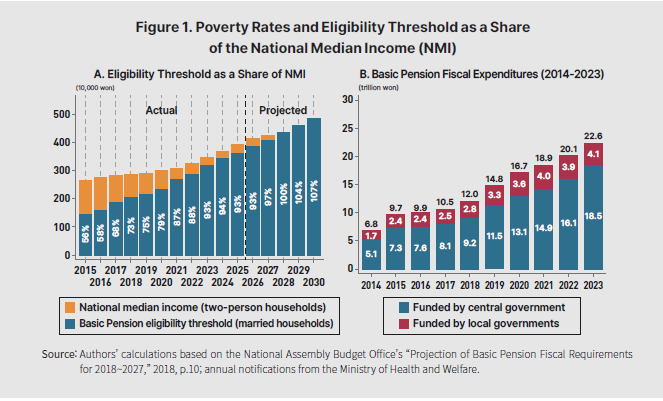
This mismatch has major fiscal implications. Beneficiaries rose from 2 million in 2015 to 6.5 million in 2023, while annual expenditures more than tripled to 22.6 trillion won—1.0% of GDP. With the elderly population expected to nearly double by 2050, pressures on the program will intensify unless reforms are made.
|
 |
|
A Rising Threshold
The problem lies in the way eligibility is determined. Currently, benefits are granted to the bottom 70% of older adults based on recognized income. But as seniors’ financial conditions improve, the eligibility threshold rises automatically, maintaining 70% coverage of the elderly. In 2015, it equaled 50% of the national median income (NMI); by 2025, it had surged to 93%, nearly matching the median household income. This automatic expansion undermines targeting and dilutes support for those who need it most.
Intergenerational Shifts
Data by birth cohort confirms that elderly poverty is declining. Those born in the 1950s and later enjoy better financial conditions, higher National Pension coverage, and larger benefits compared to earlier generations. Long-term projections suggest Korea’s elderly poverty rate will gradually fall—from over 40% a decade ago to the 30% range by 2050 and the low 20% range by 2070.
Reform Options
To better align with today’s realities, the authors propose tying eligibility to the NMI, a standard already used in public assistance programs:
- 100% of NMI: Limits eligibility to seniors below the median, cutting costs by about 19% by 2070 while minimizing disruption.
- Gradual reduction to 50% of NMI: Focuses benefits on the most vulnerable, reduces expenditures by nearly half, and frees fiscal space to increase payment levels.
Policy Direction
Reforming eligibility criteria would strengthen the pension’s role as a safety net, ease the burden on working-age taxpayers, and ensure fairness across generations. In the longer run, integrating the Basic Pension with the National Basic Livelihood Security System into a unified minimum income guarantee could create a more coherent and efficient framework for old-age income security in Korea.
■ Read a full summary
■ Insights at a glance |
 |
|
KDI Monthly Economic Trends
September 2025
Korea’s economy showed tentative signs of relief in September. Construction and facility investment remained weak, keeping manufacturing activity subdued, but consumption improved as lower interest rates and government support measures took effect. Exports were led by semiconductors yet faced mounting pressure from declining U.S. shipments under high tariffs. External uncertainty persists, with unresolved questions over semiconductor tariffs and the timing of automobile tariff adjustments.
|
|
|
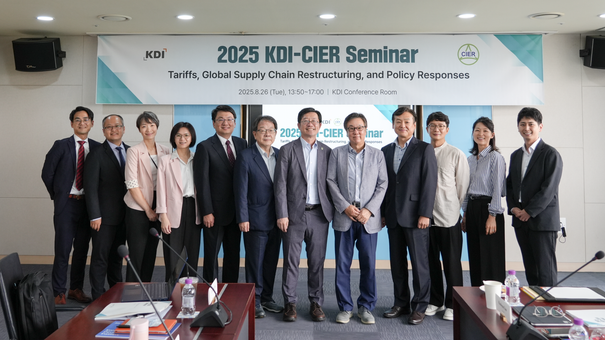 |
2025 KDI-CIER Seminar: Tariffs, Global Supply Chain Restructuring, and Policy Responses
On August 26, KDI and CIER co-hosted the 2025 KDI–CIER Seminar under the theme “Tariffs, Global Supply Chain Restructuring, and Policy Responses.” Presentations covered Korea’s evolving trade policy, Taiwan’s export shifts under the “China+1” strategy, industry-specific impacts of the trade war, and the rerouting of supply chains through third countries. Both institutes emphasized the importance of continued cooperation and joint research to strengthen resilience and policy responses in the face of global trade realignments.
|
|
|
 |
|
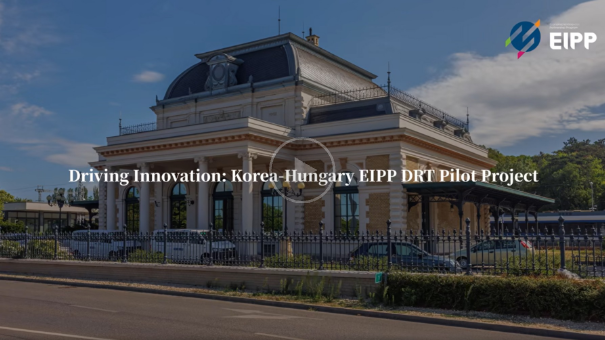
Korea–Hungary Smart Mobility Pilot Project Officially Launched
Korea’s AI-based Demand Responsive Transport (DRT) technology, developed under the Economic Innovation Partnership Program (EIPP), was launched in Europe for the first time with a pilot service in Gödöll?, Hungary (Aug–Oct 2025). Using Hyundai Motor Group’s Shucle platform, the service enhances efficiency with flexible routing, delivering lower costs, higher ridership, and reduced emissions. This public–private–academic initiative exemplifies how EIPP fosters innovation ecosystems that extend from national to global scale.
|
|
|
|