|
What's Up Monthly
April 21, 2026 | vol. 32
|
 |
Why the Capital Region Keeps Growing: Urban Accounting and Spatial Policy Implications
Why does population concentration in the Seoul Metropolitan Area (SMA) persist despite decades of balanced development policies? While infrastructure and new city expansions have been the primary tools, this study reveals a more fundamental driver: widening productivity disparities.
Productivity: The Dominant Force of Concentration
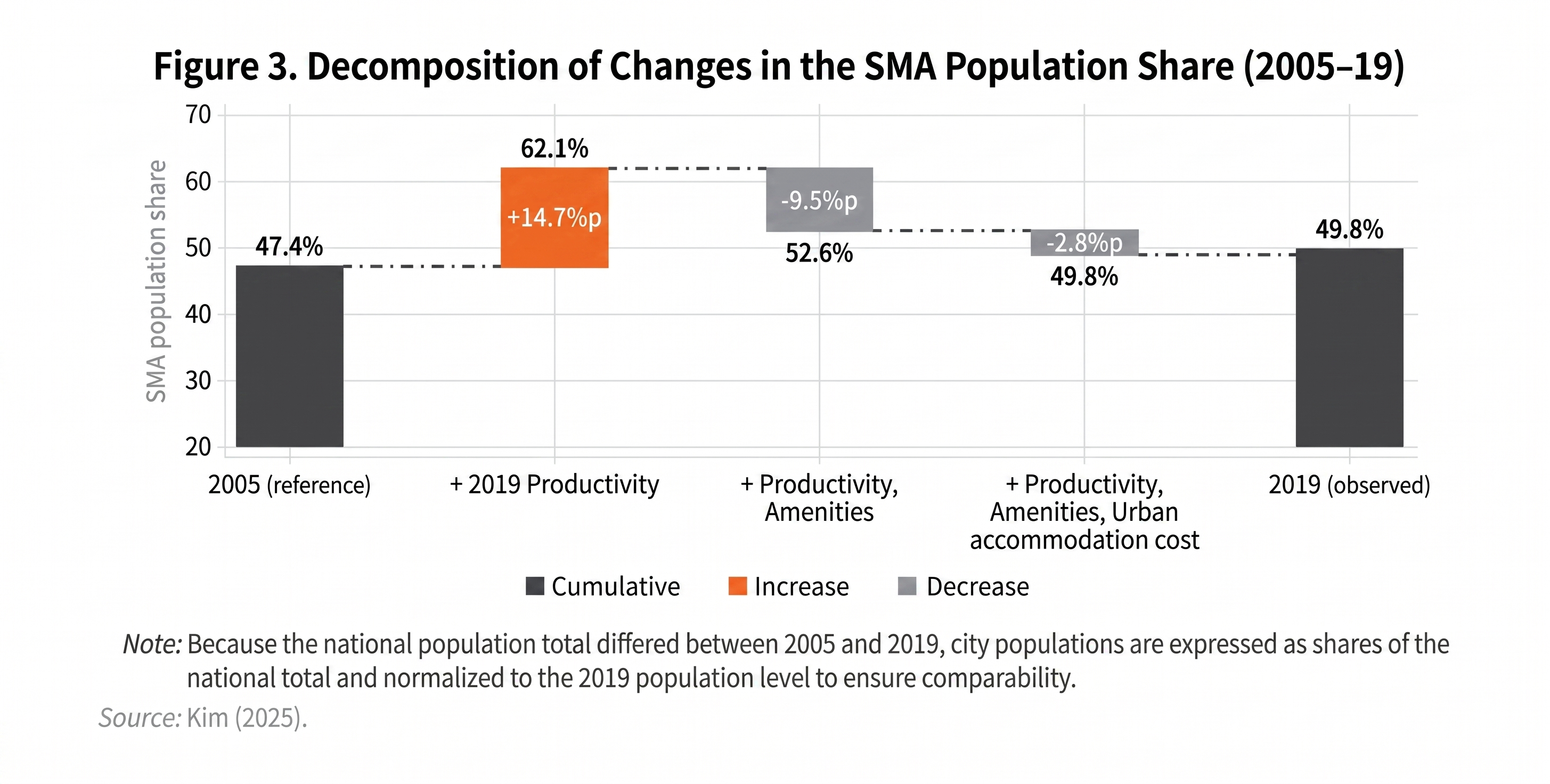
The analysis shows that productivity has been the engine of Korea’s spatial restructuring. Between 2005 and 2019, productivity in the SMA grew by 20.0%, significantly outpacing the 12.1% growth in non-capital areas. Counterfactual analysis suggests that if only productivity factors had been at play, the SMA’s population share would have already exceeded 60%. Although infrastructure investments improved local amenities and reduced congestion costs, these gains were insufficient to offset the lure of stronger wage and employment prospects in high-productivity zones.
|
 |
Industrial Shocks and Spatial Imbalance
The trend intensified in the 2010s as major manufacturing hubs suffered from industrial restructuring. If these cities maintained productivity growth in line with the national average, the concentration trend could have potentially reversed. This underscores how localized industrial shocks, particularly in traditional manufacturing, trigger large-scale labor mobility toward the SMA’s service and tech-oriented economy.
Rethinking Spatial Policy: From Infrastructure to Productivity
To achieve genuine balanced development, policy must shift from a uniform, infrastructure-centered approach to one that directly enhances regional productivity.
- Selective Concentration: Rather than dispersing resources thinly across all regions, policy should prioritize "strategic hubs"—high-potential cities that can achieve agglomeration economies.
- Managing Trade-offs: Policymakers must recognize that narrowing the gap between the capital and non-capital regions may inevitably widen disparities within those non-capital areas.
- Direct Support for Declining Areas: For smaller, shrinking cities, investment should focus on direct welfare and public services for residents rather than inefficient large-scale physical infrastructure.
Ultimately, without closing the productivity gap, improvements in living conditions alone will fail to generate durable population inflows.
- Read more
- Insights at a glance
|
 |
|
KDI Monthly Economic Trends (April 2026)
Domestic activity remains on an improving trend as consumption and exports, particularly semiconductors, maintain steady growth. In February, all-industry production rose by 2.6% on a two-month average basis, supported by a surge in semiconductor output and robust service sector performance. Equipment investment also grew strongly, while the contraction in construction investment showed signs of moderating.
External conditions have softened, however, as the conflict drove global oil prices higher and disrupted supply chains. These pressures contributed to a decline in both business and consumer sentiment, with the Composite Consumer Sentiment Index falling from 112.1 to 107.0 in March. Furthermore, rising petroleum prices are expected to broaden inflationary pressures and may constrain the recovery of domestic investment.
|
 |
|
Why has Korea’s household debt continued to rise even as interest rates declined? This video highlights how demographic shifts, especially rising life expectancy, have strengthened incentives for asset accumulation, expanding the supply of funds and driving debt growth. It shows that older cohorts build financial assets while younger households borrow to finance housing, creating intergenerational financial flows. The findings suggest that as population aging accelerates and longevity gains slow, household debt is likely to peak and gradually decline.
- Watch the full video
- Read the full written report
|
|
KDI Journal of Economic Policy (Feb 2026)
|
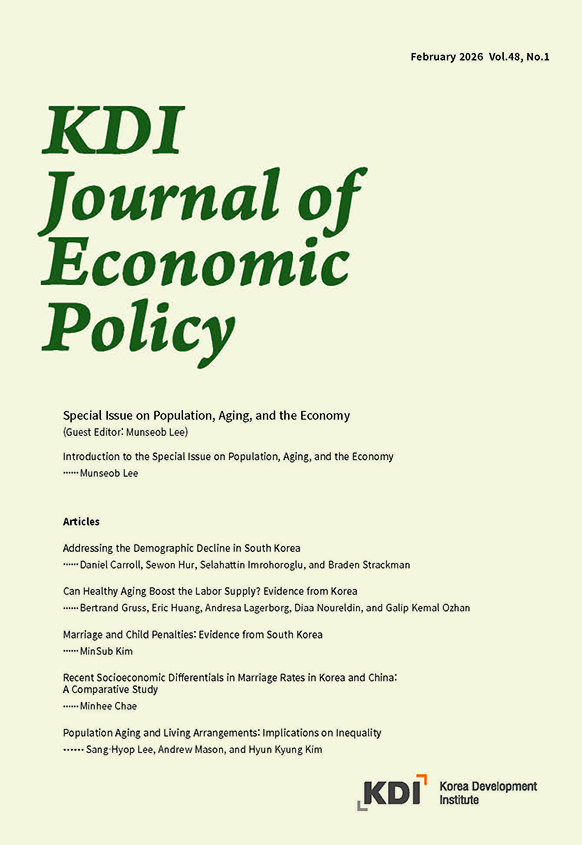
As South Korea and the global community face unprecedented demographic transitions, the February issue of the KDI Journal of Economic Policy (JEP) brings together rigorous research focused on "Population, Aging, and the Economy."
From labor supply dynamics to the underlying causes of declining marriage rates, these five pivotal studies offer critical insights into the structural shifts shaping our economic landscape and provide evidence-based policy frameworks for a sustainable future.
- Discover more
|