
정책연구시리즈 정부형태와 경제안보 2026.02.28
Series No. 2026-02
-
김재훈 선임연구위원
 프로필
프로필
- 국문요약
-
이 보고서는 정부형태와 경제안보 간의 관계를 탐구하며, 민주주의 국가들에서 정치체제가 경제발전에 미치는 영향을 분석한다. 기존 연구들이 민주주의와 권위주의 체제의 이분법적 비교에 치중한 데 비해, 이 연구는 OECD 고소득 민주 국가들의 미시적 제도 조합(정부형태, 선거규칙, 권력구조)이 정부역량을 통해 장기 경제 수준에 미치는 조건부 효과를 실증적으로 규명한다. 워싱턴 컨센서스와 베이징 컨센서스의 양극단을 넘어, 민주적 제도 내에서 정부역량의 경제적 환산 효율이 핵심 결정요인임을 강조한다.
문헌 고찰 부분에서, 민주주의가 경제성장에 미치는 영향에 대한 상반된 견해를 검토한다. 일부 연구는 민주주의가 재산권 보호와 투자 유인을 강화해 성장을 촉진한다고 주장하나, 다른 연구는 정책 지연과 포퓰리즘으로 인해 성장을 저해할 수 있다고 지적한다. 대통령제는 장기적인 안정성과 집행력을, 의원내각제는 유연성과 합의를 장점으로 꼽지만, 실증 결과는 모호하다. 최근 Acemoglu et al.(2019)처럼 성장률 대신 소득수준을 종속변수로 한 분석에서 민주주의의 긍정 효과가 확인되며, 이는 단기 변동성을 통제한 장기 누적 효과를 포착하기 때문으로 설명된다.
분석 방법으로, OECD 38개국(1995~2023년)의 패널 데이터를 활용해 Arellano-Bover/Blundell-Bond System GMM을 적용한다. 종속변수는 ln(GDP per capita)로 경제발전 수준을 측정하며, 정치체제 더미(대통령제, 세미대통령제, 의원내각제; 소선거구제, 중대선거구제; 삼권분립, 권력융합)와 정부역량 지표(정부 효과성, 부패통제, 정치 안정성, 규제품질, 법치주의)의 교차항을 핵심 설명변수로 사용한다. 통제변수로는 역사적 유산(스페인 식민지, 구소련 경험, 스칸디나비아 법적 기원), 경제 구조(무역 의존도, 인플레이션, FDI, 석유지대), 인구구조(고령화)를 포함해 내생성 문제를 완화한다.
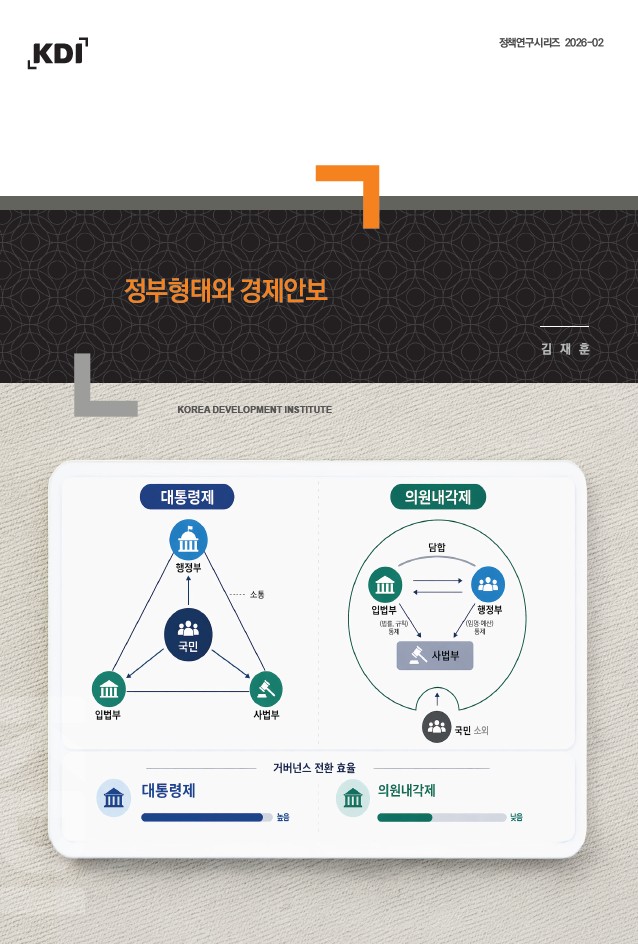
실증 결과, 대통령제 + 소선거구제 + 삼권분립 조합이 정부역량 개선 시 소득수준을 가장 크게 상승시키는 것으로 나타난다. 정부 효과성 1단위 개선은 대통령제(ps)에서 47.1% 상승(실질 60.2%)을 보이지만, 의원내각제(cm)에서는 거의 무의미하다. 부패통제와 법치주의도 유사하며, 규제품질은 4~7% 상승 효과를 보인다. 정치 안정성은 대통령제에서 긍정적이지만, 의원내각제에서 역효과를 초래한다. 이는 대통령제의 고정 임기와 생존 분리가 장기 개혁 유인을 강화하고, 소선거구제의 상향식 공천이 정치 안정성을 보장하기 때문으로 해석된다.
정책 함의로, 한국처럼 단임제와 하향식 공천의 취약성을 가진 대통령제는 개혁이 필요하다. 4년 중임제의 도입으로 장기 시야를 확보하고, 중간선거로 분점정부를 협상 기회로 전환하며, 상향식 공천으로 입법 독립성을 강화할 것을 제안한다. 또한 헌법 개정 시 현직 정치인 배제와 시민 참여를 강조해 대리인 문제를 차단해야 한다. 이는 민주적 제도 내 경제안보를 완성하는 ‘제도적 삼위일체’로, 워싱턴-베이징 양극단 이후의 세계를 대비한 로드맵이 될 것이다.
본 연구는 OECD 고소득 민주 국가에 한정되어 개발도상국이나 권위주의 체제에 일반화하기 어렵다는 점이 한계다. 또한 제도적 이질성이 낮아 체제 자체 효과의 식별이 제한되며, 권위주의 모델의 장점을 포착하지 못한다. 그러나 경제 성과 및 법치와 부패통제 수준이 높은 제도적 환경에서 미세 조정을 통해 효율을 최적화하는 실증 증거를 제공하고 있다.
- 영문요약
-
This report explores the relationship between government forms and economic security, analyzing how political systems in democratic countries influence economic development. Unlike previous studies that focus on dichotomous comparisons between democracy and authoritarianism, this research empirically identifies the conditional effects of micro-institutional combinations in OECD high-income democracies―such as government type, electoral rules, and power structures―on long-term economic levels through government capacity. It emphasizes that beyond the polar extremes of the Washington Consensus and the Beijing Consensus, the economic conversion efficiency of government capacity within democratic institutions is the key determinant.
The literature review examines contrasting views on the impact of democracy on economic growth. Some studies argue that democracy promotes growth by strengthening property rights and investment incentives, while others point out that it can hinder growth due to policy delays and populism. Presidential systems are praised for long-term stability and executive power, whereas parliamentary systems are noted for flexibility and consensus, though empirical results are mixed. Recent analyses, like Acemoglu et al. (2019), confirm positive effects of democracy when using income levels rather than growth rates as the dependent variable, as this captures long-term cumulative effects while controlling for short-term volatility.
For the analytical method, panel data from 38 OECD countries (1995-2023) is utilized with the Arellano-Bover/Blundell-Bond System GMM. The dependent variable is ln(GDP per capita) to measure economic development levels, with political system dummies (presidential, semi-presidential, parliamentary; single-member district, multi-member district; separation of powers, fusion of powers) and their interactions with government capacity indicators (government effectiveness, control of corruption, political stability, regulatory quality, rule of law) as key explanatory variables. Control variables include historical legacies (Spanish colony, former USSR, Scandinavian legal origin), economic structures (trade dependence, inflation, FDI, oil rents), and demographic factors (aging) to mitigate endogeneity.
Empirical results show that the combination of presidential system + single-member district + separation of powers yields the greatest increase in income levels from improvements in government capacity. A 1-unit improvement in government effectiveness leads to a 47.1% rise (real 60.2%) in presidential systems (ps), but is nearly insignificant in parliamentary systems (cm). Similar patterns hold for control of corruption and rule of law, with regulatory quality showing 4-7% uplift effects. Political stability is positive in presidential systems but has reverse effects in parliamentary ones. This is interpreted as the fixed terms and separate survival in presidential systems enhancing incentives for long-term reforms, while bottom-up nominations in single-member districts ensure political stability.
Policy implications suggest that for countries like Korea, with vulnerabilities in single-term presidencies and top-down nominations, reforms are needed. Introducing a four-year re-election system to secure long-term vision, midterm elections to turn divided governments into negotiation opportunities, and bottom-up nominations to strengthen legislative independence are recommended. Constitutional amendments should exclude incumbent politicians and emphasize citizen participation to block agency problems. This forms an "institutional trinity" to complete economic security within democracy, providing a roadmap for the post-Washington-Beijing world.
Research limitations include its restriction to OECD high-income democracies, making generalization to developing countries or authoritarian regimes difficult. The low institutional heterogeneity limits identification of regime effects themselves, and it fails to capture advantages of authoritarian models. However, it provides empirical evidence for optimizing efficiency through fine-tuning in high-institutional environments.
- 목차
-
발간사
요 약
제1장 서 론
제2장 관련 문헌
제1절 정부형태와 권력분할/융합
제2절 선거제도
제3절 정치체제와 경제성장
제3장 이론적 논의와 가설
제1절 이론적 논의
제2절 가설 설정
제4장 분석 방법
제1절 분석 모형
제2절 변수, 분석자료와 기술통계
제5장 실증분석
제1절 정치체제와 장기 경제발전 수준
제2절 정치제도와 정부역량
제3절 이론적·정책적 함의
제6장 결론 및 정책적 시사점
제1절 결과 요약
제2절 정책적 함의와 제도 설계 원칙
제3절연구의 한계
참고문헌
부 록
ABSTRACT
더 자세히 알고 싶으면?
동일 주제 자료 ( 9 )
- 주요 관련자료

한국개발연구원의 본 저작물은 “공공누리 제3유형 : 출처표시 + 변경금지” 조건에 따라 이용할 수 있습니다. 저작권정책 참조
보안문자 확인
무단등록 및 수집 방지를 위해 아래 보안문자를 입력해 주세요.
KDI 직원 정보 확인
KDI 직원 정보 확인
담당자 정보를 확인해 주세요. 044-550-5454
등록완료
소중한 의견 감사드립니다.
등록실패
잠시 후 다시 시도해주세요.